The
Jelly Belly Bean Art Gallery
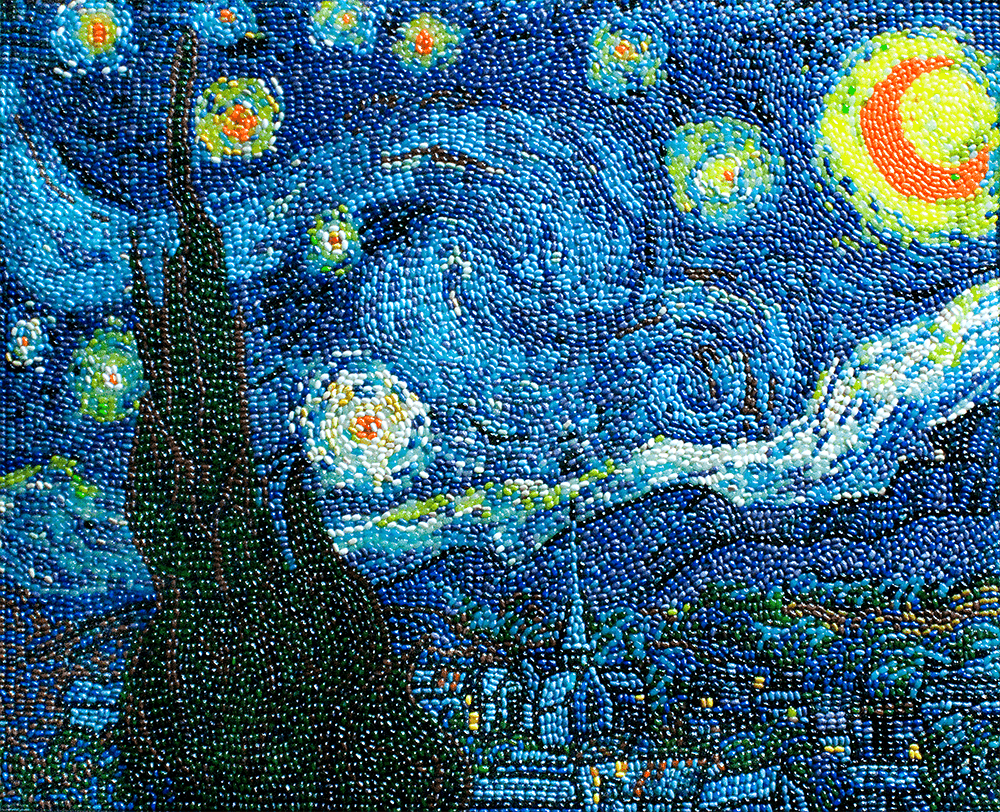
The Starry Night
In celebration of Vincent van Gogh's masterwork, The Starry Night, Jelly Belly commissioned artist Kristen Cumings to recreate the famous image completely in Jelly Belly jelly beans. Because Van Gogh's brush strokes went in a circular, swirling pattern, Cumings had to place each individual bean in the same direction as the brushstroke to mimic the effect and recreate it on a larger scale.
The Starry Night
Artist: Kristen Cumings
Dimensions: 4' x 5'
Main Palette
 Blueberry
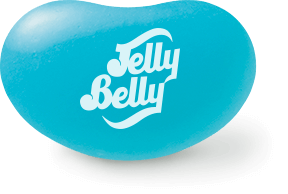 Berry Blue
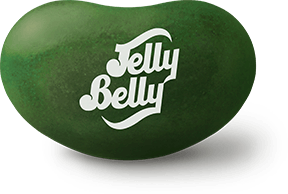 Watermelon
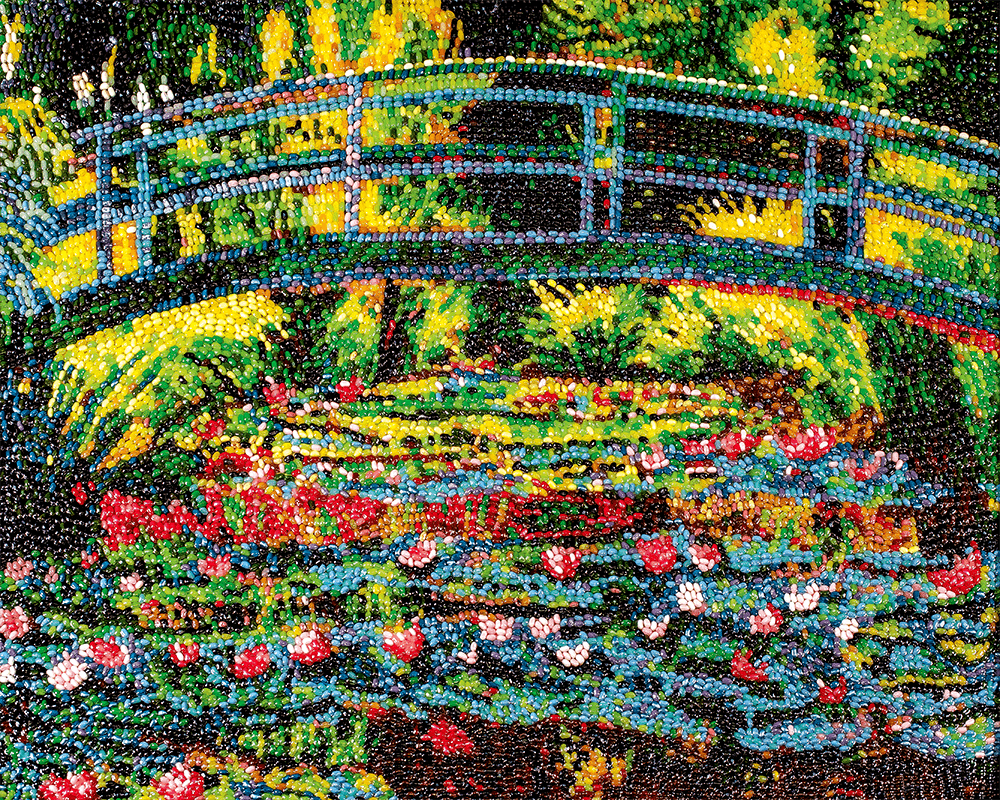
Water Lillies
Made completely out of Jelly Belly jelly beans, artist Kristen Cumings recreated Claude Monet’s Water Lilies with a sweet twist. Jelly Belly bean flavors found in this piece include jewel island punch, chili mango, and Juicy Pear
Water Lillies
Artist: Kristen Cumings
Dimensions: 4' x 5'
Main Palette
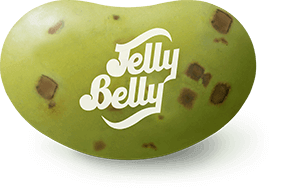 Juicy Pear
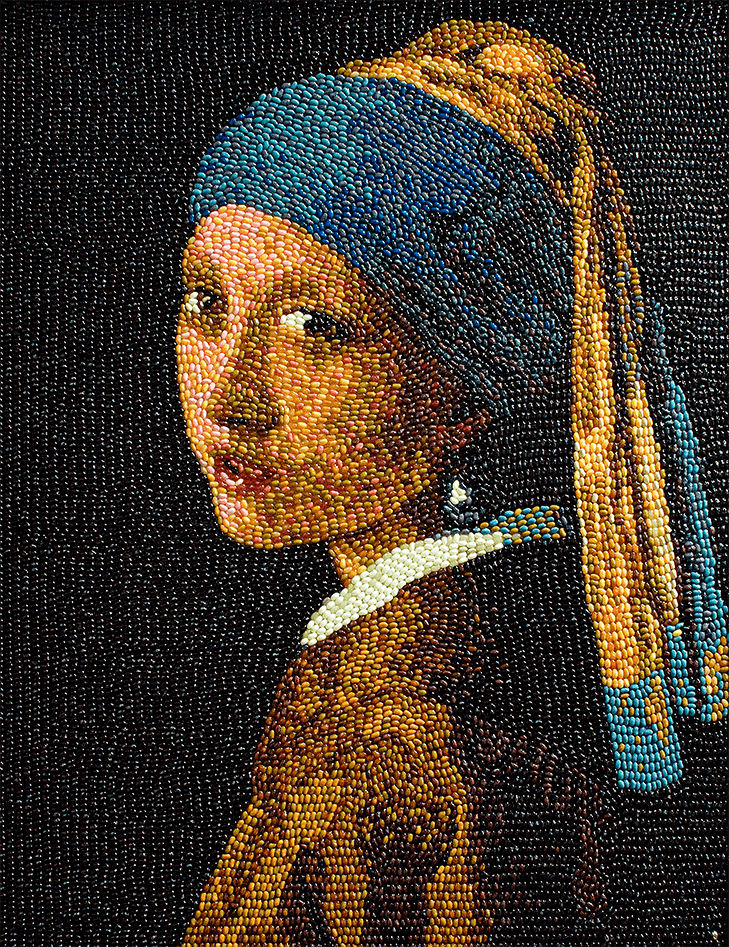
Girl with a Pearl Earring
Known as 'The Mona Lisa of the North,' Jelly Belly commissioned a recreation of Johannes Vermeer's masterwork, Girl with a Pearl Earring, made completely from Jelly Belly jelly beans. The artwork's focal point, a dangling pearl earring, was created using three different flavours of Jelly Belly beans to achieve the same effect as Vermeer's work.
Girl with a Pearl Earring
Artist: Kristen Cumings
Dimensions: 5' x 4'
Main Palette
Berry Blue
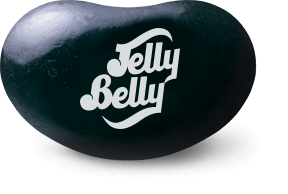 Liquorice
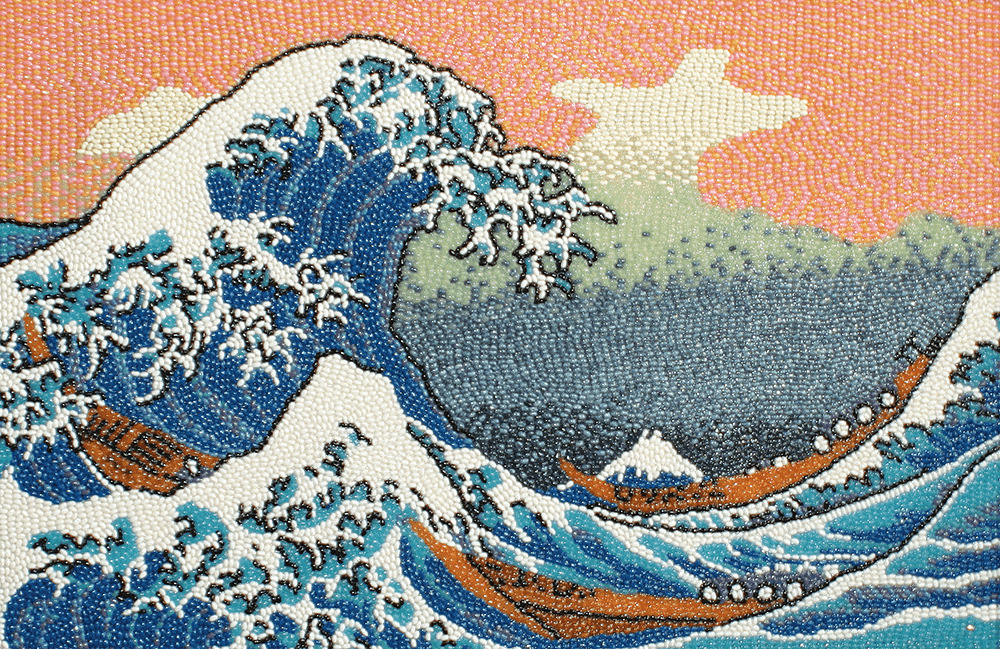
The Great Wave Off Kanagawa
Katsushika Hokusai's The Great Wave Off Kanagawa is comprised of a wide range of Jelly Belly bean flavours used to capture the intense blue of the waves and the white of the foam caps. The artist went to great lengths to recreate the intricate details of the original wood block print, even using just three beans to depict the fishermen kneeling on the boats caught in the waves.
The Great Wave Off Kanagawa
Artist: Kristen Cumings
Dimensions: 4' x 6'
Main Palette
 Coconut
 Cotton Candy
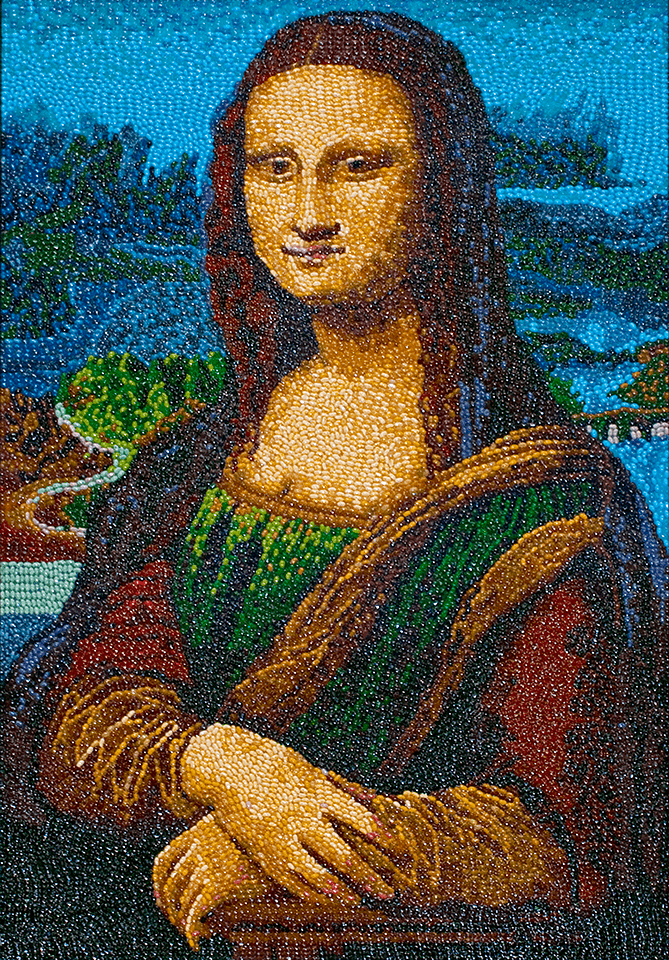
Mona Lisa
Made completely from Jelly Belly jelly beans, artist Kristen Cumings recreated Leonardo Da Vinci's masterpiece with a sweet twist. The Jelly Belly Mona Lisa is reflective of what art historians believe the original colours may have looked like before almost 600 years of wear and tear.
Mona Lisa
Artist: Kristen Cumings
Dimensions: 6' x 4'
Main Palette
Berry Blue
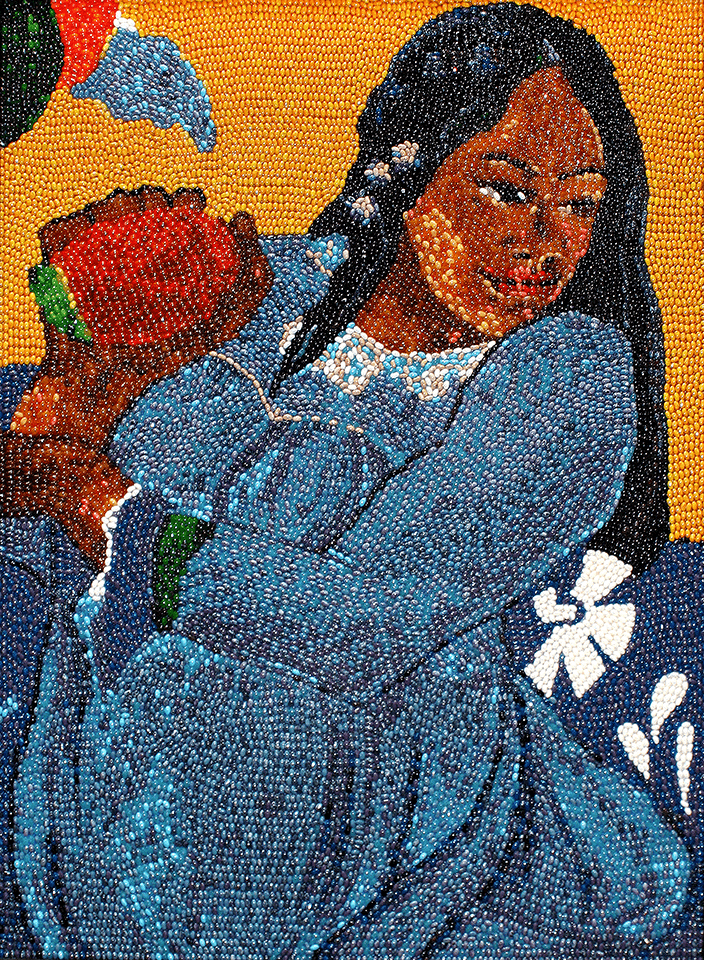
Woman with a Mango
While working in the blues and purples to recreate the woman's dress in Jelly Belly beans, artist Kristen Cumings became enamored with the range of blues and the flavour Island Punch. A fitting flavour for a tribute to the islands and the people of Tahiti.
Woman with a Mango
Artist: Kristen Cumings
Dimensions: 5' x 4'
Main Palette
 Hot Cinnamon
Liquorice
Hot Cinnamon
Liquorice
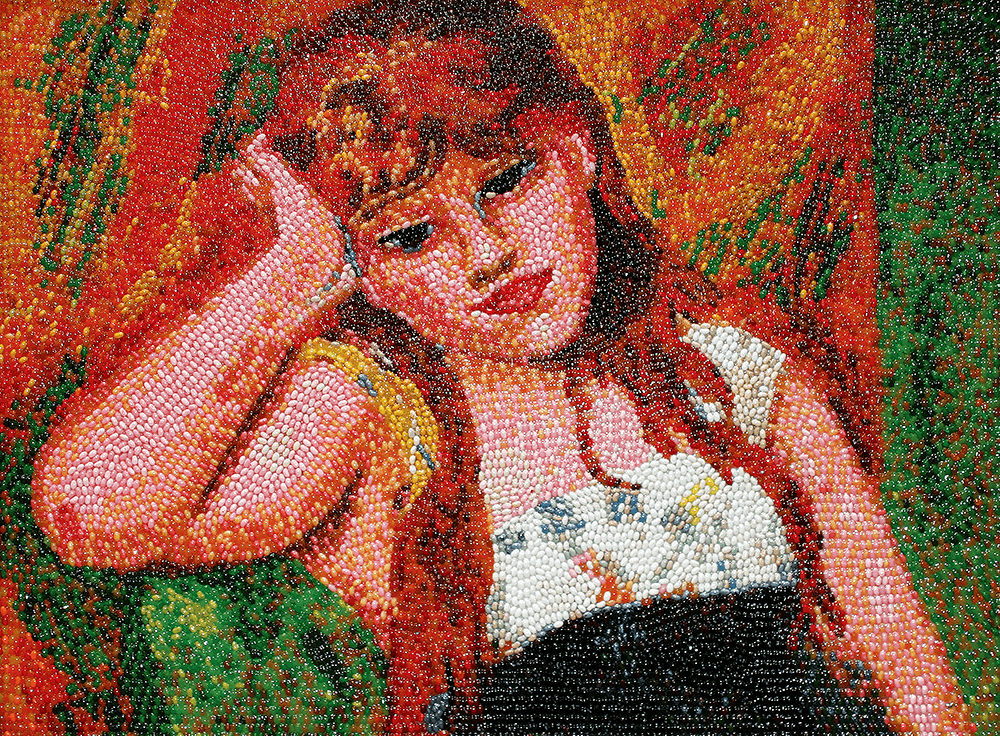
Young Blonde Girl
The bright candy colours of the original painting expanded artist Kristen Cumings colour palette of Jelly Belly beans into a brilliant new range, a fitting tribute to both the colourful confections and Impressionism of Renoir's original. This piece in the Masterpieces of Jelly Bean Art collection from Jelly Belly is a happy slice of real life that speaks to us today.
Young Blonde Girl
Artist: Kristen Cumings
Dimensions: 4' x 5'
Main Palette
 Bubble Gum
 Green Apple
Liquorice
Coconut
Green Apple
Liquorice
Coconut
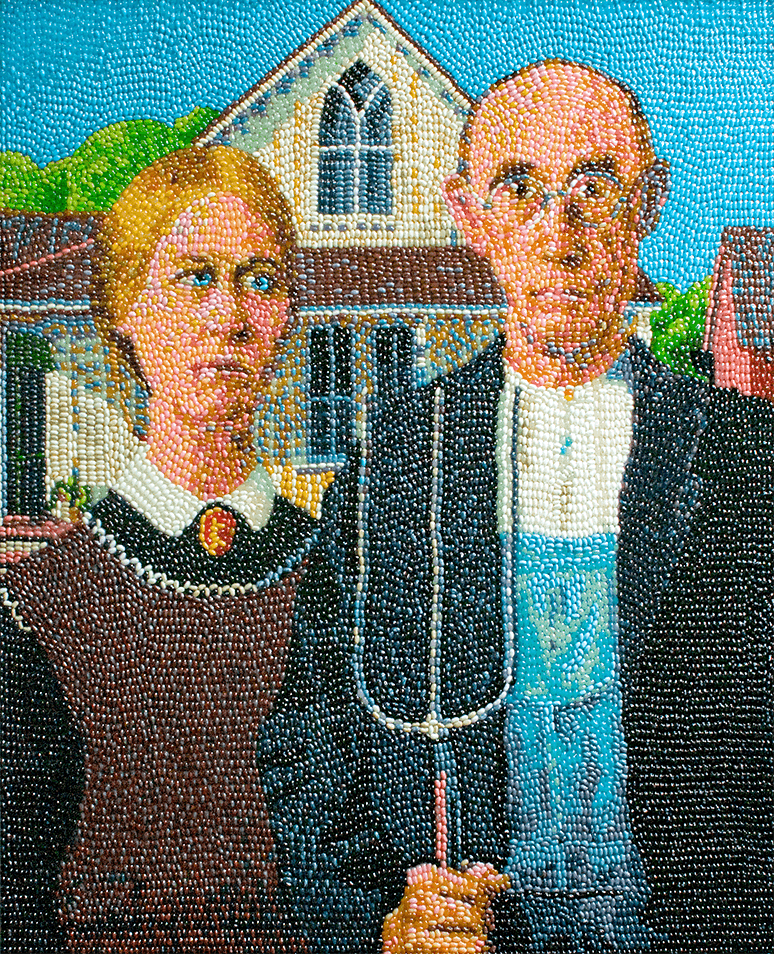
American Gothic
A sweet take on farm families and life in the American Midwest, the Jelly Belly reproduction of Grant Wood's American Gothic* is a fitting tribute for a candy family whose roots began in Belleville, Illinois. The direct descendents of Gustav Goelitz who started making candy in 1869 are now leading the Jelly Belly Candy Company.
American Gothic
Artist: Kristen Cumings
Dimensions: 4.5' x 5.5'
Main Palette
Berry Blue
Liquorice
Coconut
Bubble Gum
Orangutan
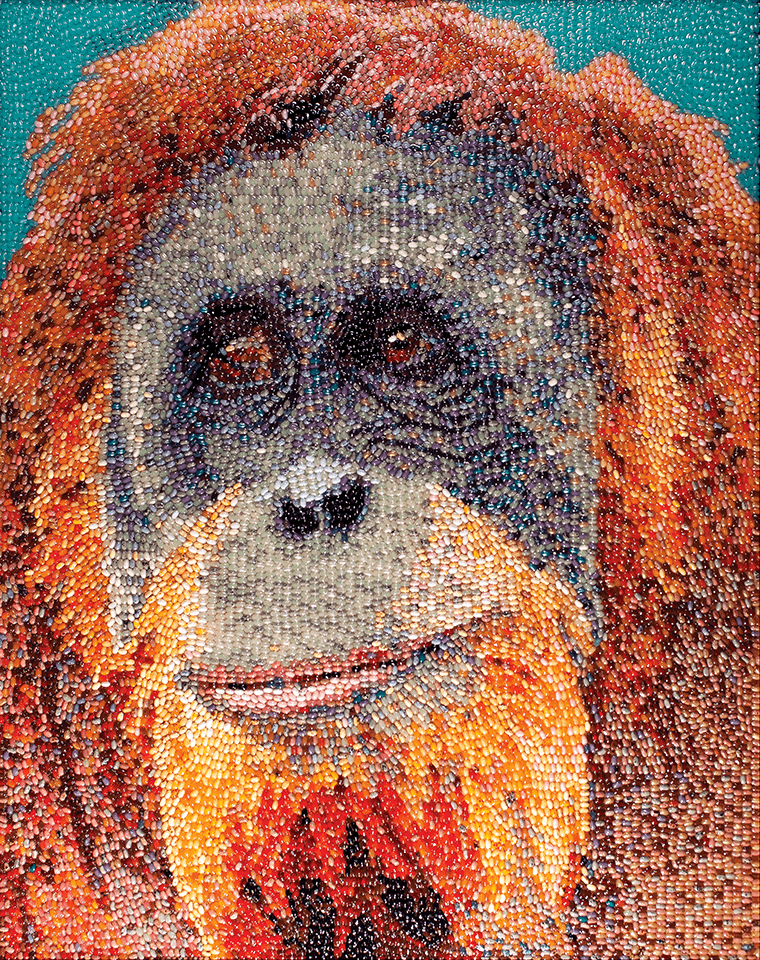
Orangutans are found in the wild only Sumatra and Borneo. With an arm span of 7 feet from fingertip to fingertip, these primates are ideal for life in the canopy. Highly intelligent and a close relative to humans, the Jelly Belly Orangutan looks out at viewers with eyes made of Red Apple, Berry Smoothie, Plum and Licorice Jelly Belly® jelly beans.
Orangutan
Artist: Kristen Cumings
Dimensions: 5' x 4'
Main Palette
Berry Blue
 Peach
Peach
Canadian Swift Foxes
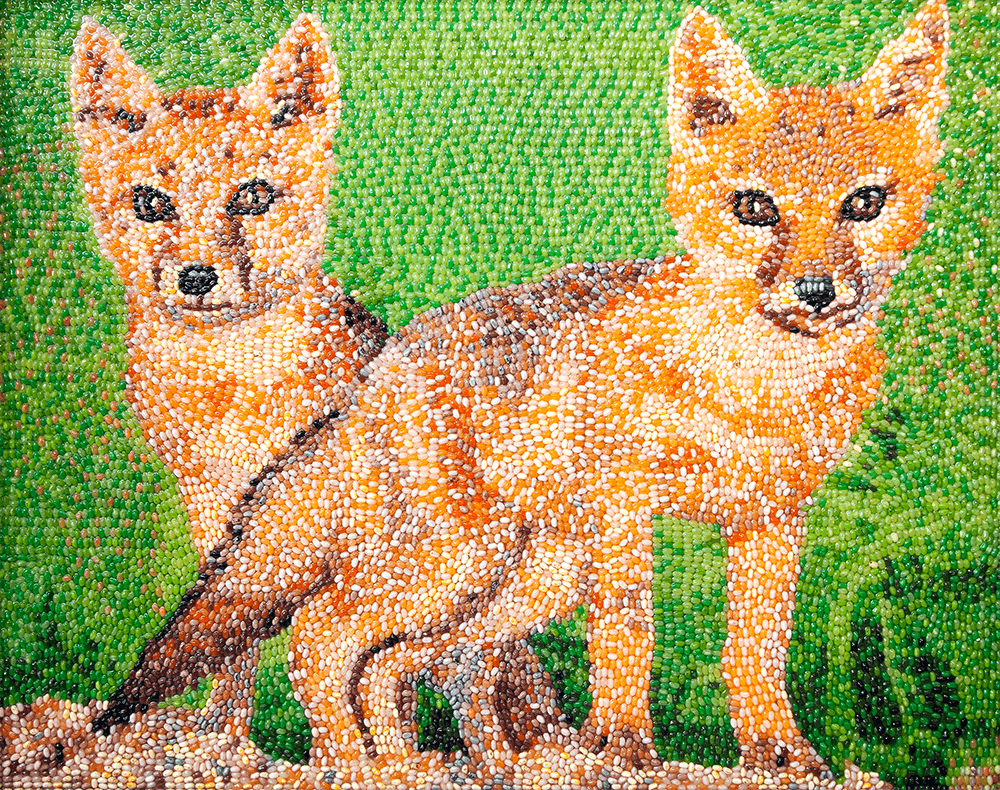
These cute critters are native to the Alberta and Saskatchewan area and on Canada’s endangered species list. The portrait was created in Montreal using Pink Grapefruit, Orange, Cantaloupe/Melon, Strawberry Daiquiri and a bevy of other Jelly Belly flavours to capture the Swift Fox’s playful nature.
Canadian Swift Foxes
Artist: Kristen Cumings
Dimensions: 4' x 5'
Main Palette
Green Apple
 Lemon Lime
Berry Blue
Lemon Lime
Berry Blue
 Lemon
Lemon
 Buttered Popcorn
Tribute to the Golden State Grizzly
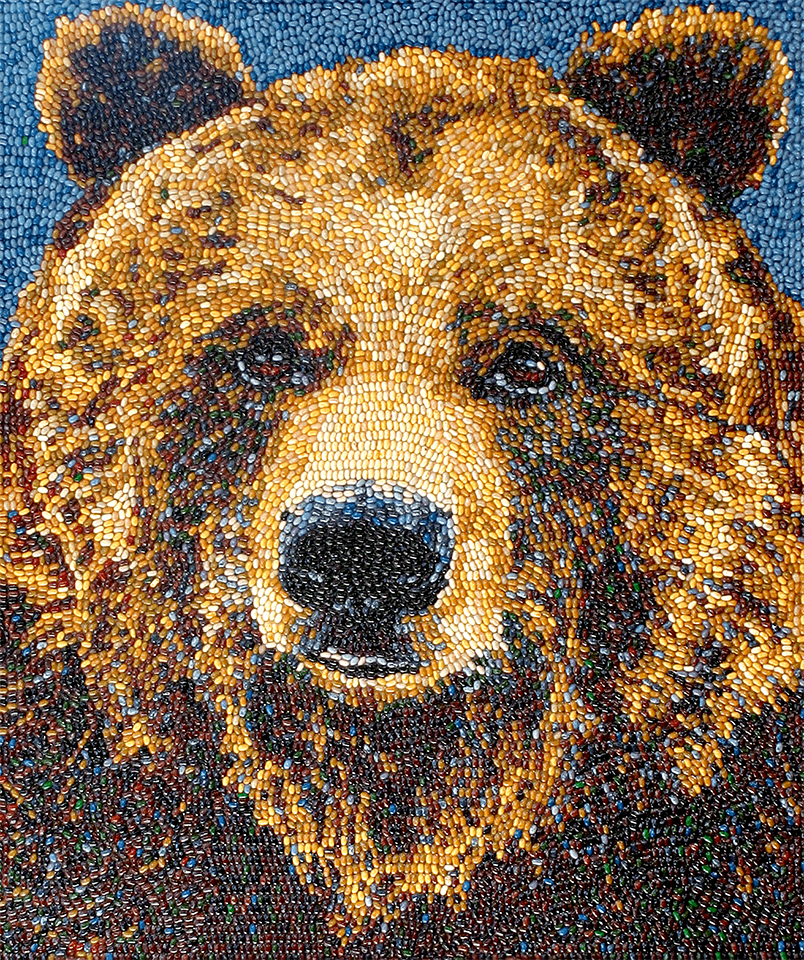
The Grizzly Bear adorns the California State Flag and is the inspiration for University of California Golden Bears. The majestic creature known for its strength and speed is an enduring symbol of the State's earliest days when settlers and bears shared the wilderness.
Tribute to the Golden State Grizzly
Artist: Kristen Cumings
Dimensions: 5' x 4'
Main Palette
 Cappuccino
Liquorice
Blueberry
Cappuccino
Liquorice
Blueberry
Giant Panda
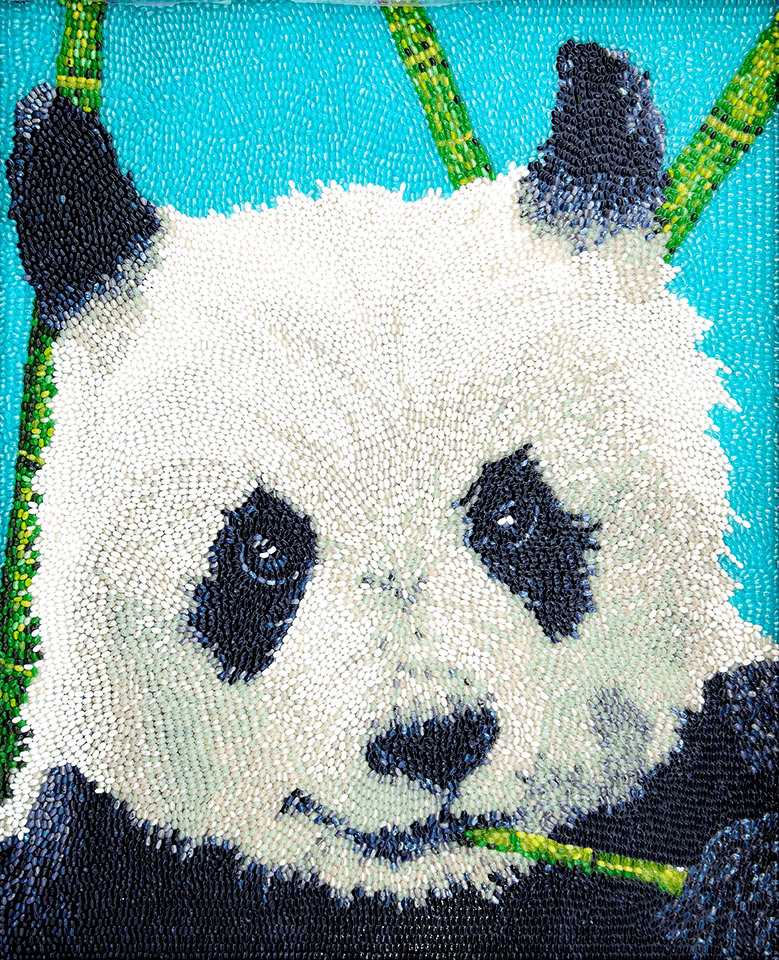
This cuddly bear is munching on a bamboo stick made of Lime, Green Apple and Watermelon Jelly Belly jelly beans. Our Giant Panda comes to life with Coconut, Cream Soda, Licorice and Plum Jelly Belly beans. The creation of the portrait was broadcast live on the internet from the Jelly Belly Visitor Centre in California to celebrate National Jelly Bean Day 2014 with fans around the world.
Giant Panda
Artist: Kristen Cumings
Dimensions: 5' x 4'
Main Palette
 Lime
Green Apple
Watermelon
Coconut
Liquorice
Lime
Green Apple
Watermelon
Coconut
Liquorice
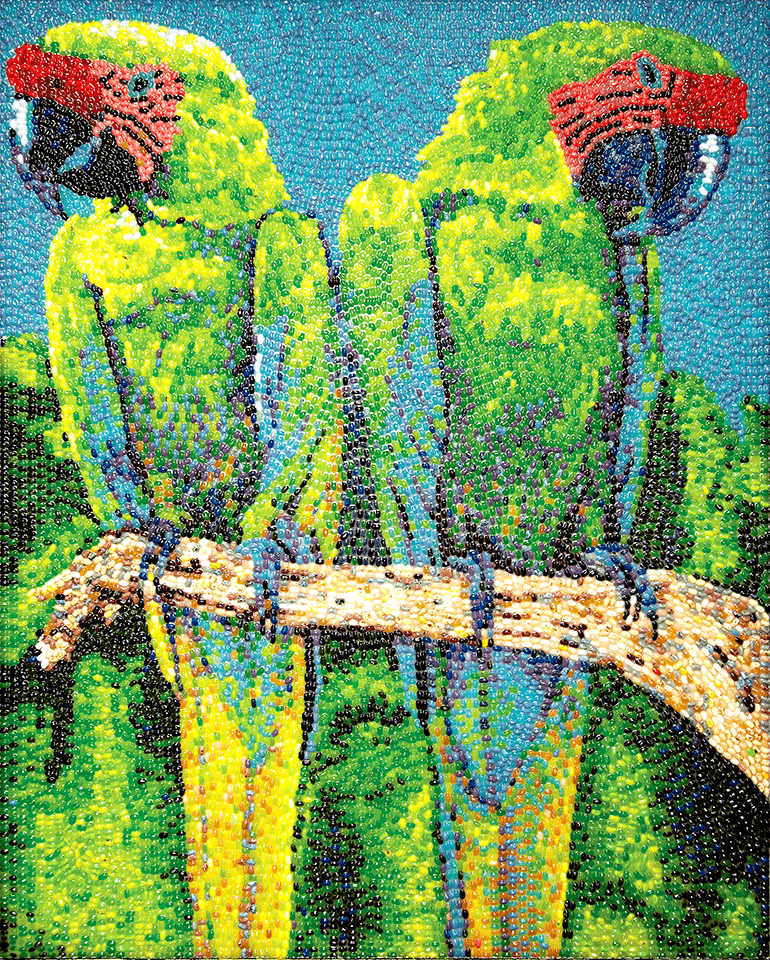
Great Green Macaw
These beautiful birds have a wingspan of up to 50 inches and live in deep canyons and plateaus in Central America. The bright green feathers are brought to life with an array of Green Apple, Lime and Juicy Pear jelly beans.
Great Green Macaw
Artist: Kristen Cumings
Dimensions: 5' x 4'
Main Palette
 Red Apple
Lemon Lime
Green Apple
Green Apple
Red Apple
Lemon Lime
Green Apple
Green Apple
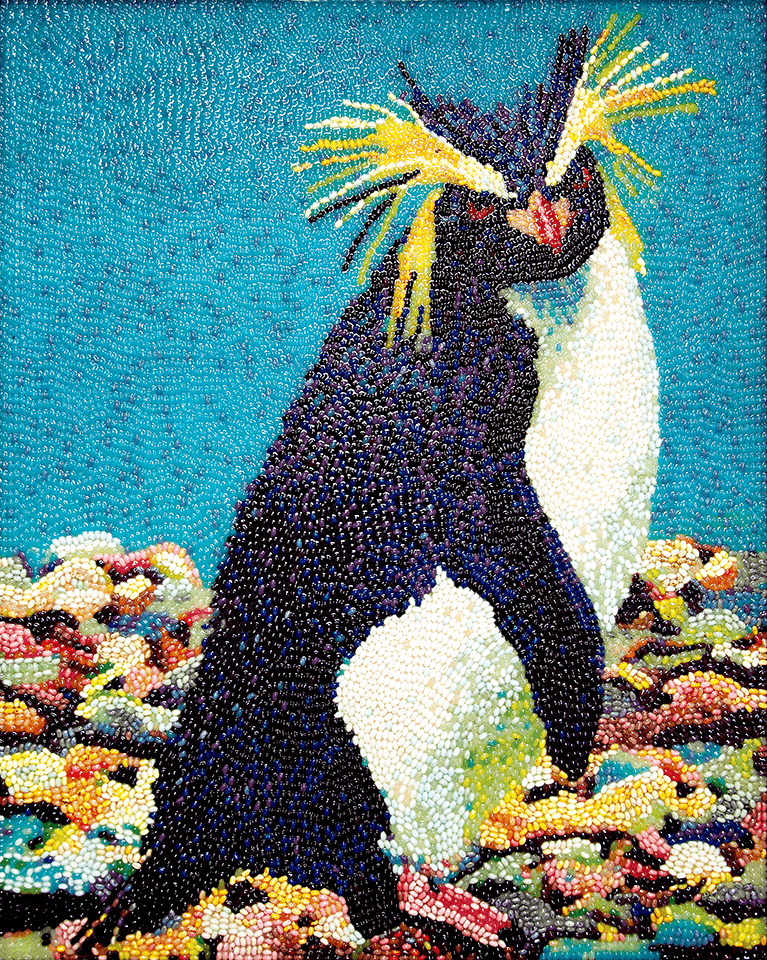
Rockhopper Penguin
Found among the craggy shorelines of Antarctica, Chile and New Zealand these penguins are only 20 inches tall, the world’s smallest penguins. Their distinctive yellow plumes over their brow and head are made with Lemon, Buttered Popcorn and Top Banana Jelly Belly jelly beans.
Rockhopper Penguin
Artist: Kristen Cumings
Dimensions: 5' x 4'
Main Palette
Berry Blue
Liquorice
Lemon
Coconut
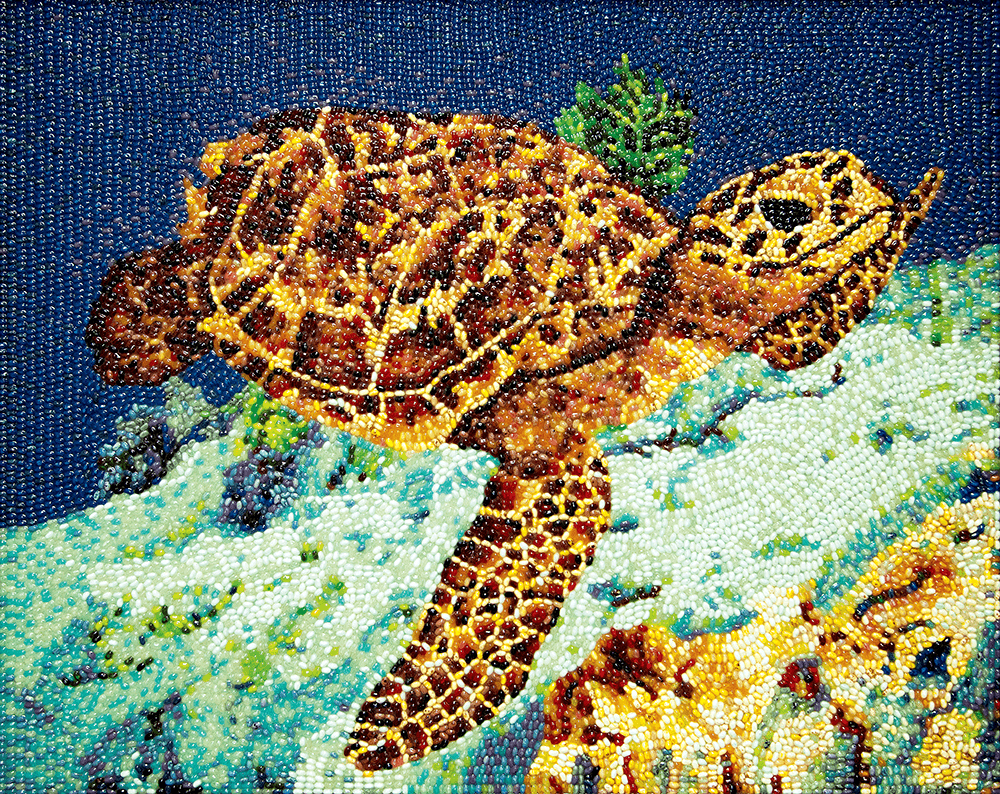
Hawksbill Sea Turtle
A dazzling tribute to the majestic Hawksbill Sea Turtle. Found in tropical waters of the Atlantic, Pacific and Indian Oceans, this depiction finds the critically endangered turtle in a sea of Blueberry Jelly Belly beans.
Hawksbill Sea Turtle
Artist: Kristen Cumings
Dimensions: 4' x 5'
Main Palette
Blueberry
Berry Blue
Watermelon
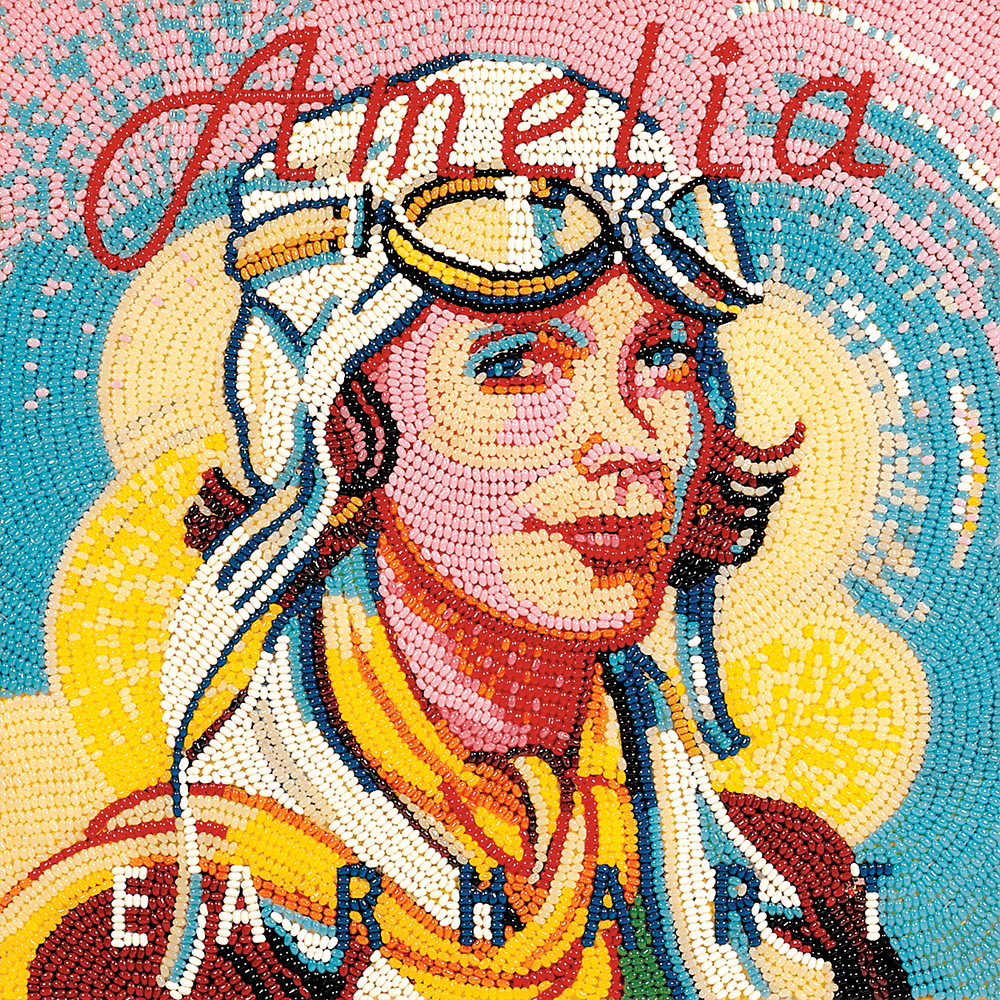
Amelia Earhart
The image of the legendary pilot consists mainly of Berry Blue, Cotton Candy, Buttered Popcorn, Lemon, Very Cherry and Coconut flavoured jelly beans.
Amelia Earhart
Artist: Peter Rocha
Dimensions: 4' x 4'
Main Palette
Berry Blue
Cotton Candy
Buttered Popcorn
Lemon
 Very Cherry
Diana, Princess of Wales
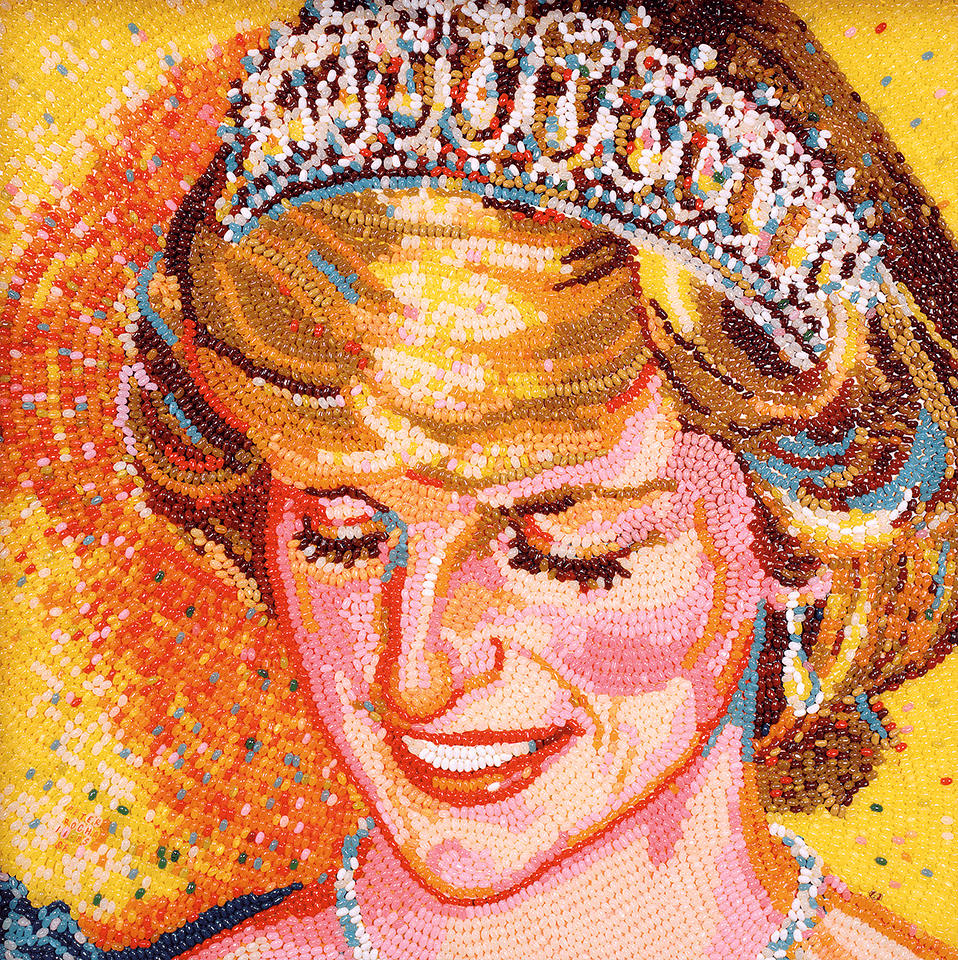
Consisting of 9,770 beans, this piece was commissioned upon the Princess's visit to the White House in 1985.
Diana, Princess of Wales
Artist: Roger Rocha
Dimensions: 4' x 4'
Main Palette
Bubble Gum
Cotton Candy
Lemon
Elvis Presley
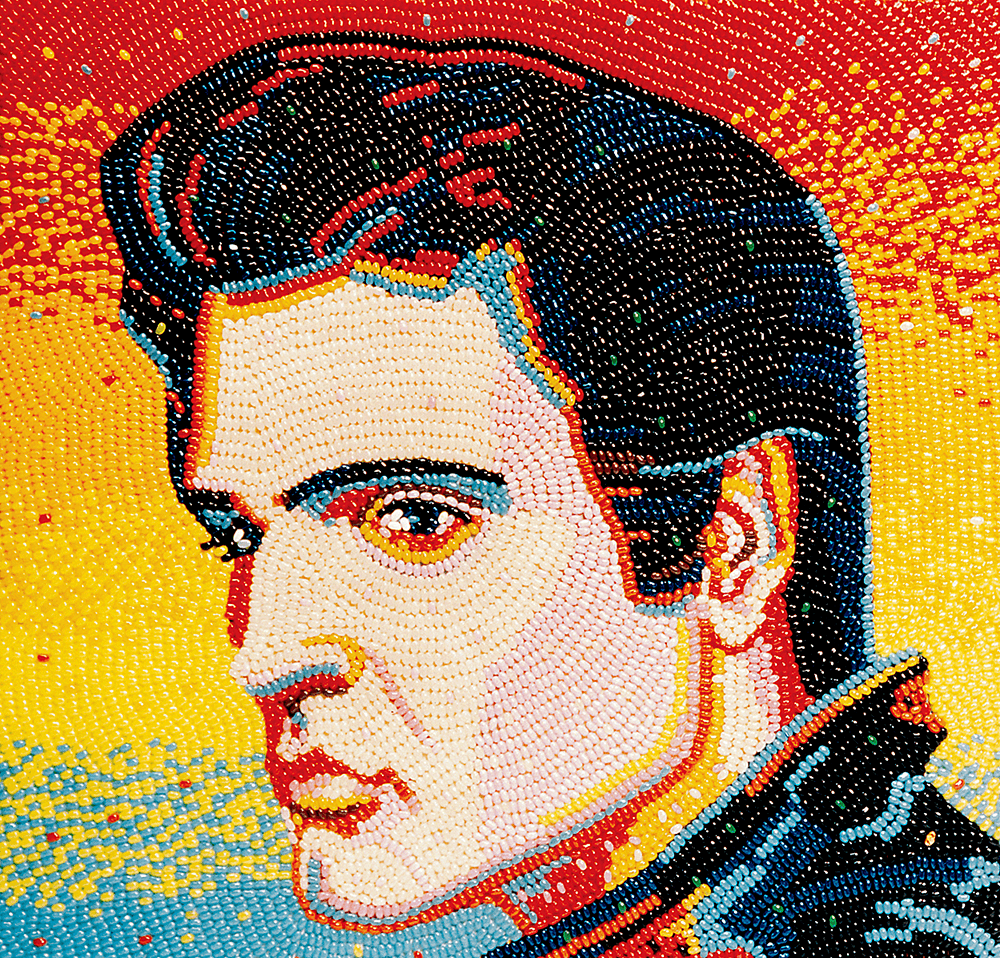
The King of Rock and Roll's trademark hair was brought to life with a combination of Licorice, Blueberry, Very Cherry, Berry blue and Raspberry flavours.
Elvis Presley
Artist: Roger Rocha
Dimensions: 4' x 4'
Main Palette
Liquorice
Blueberry
Very Cherry
Berry Blue
 Raspberry
Elvis Presley 2
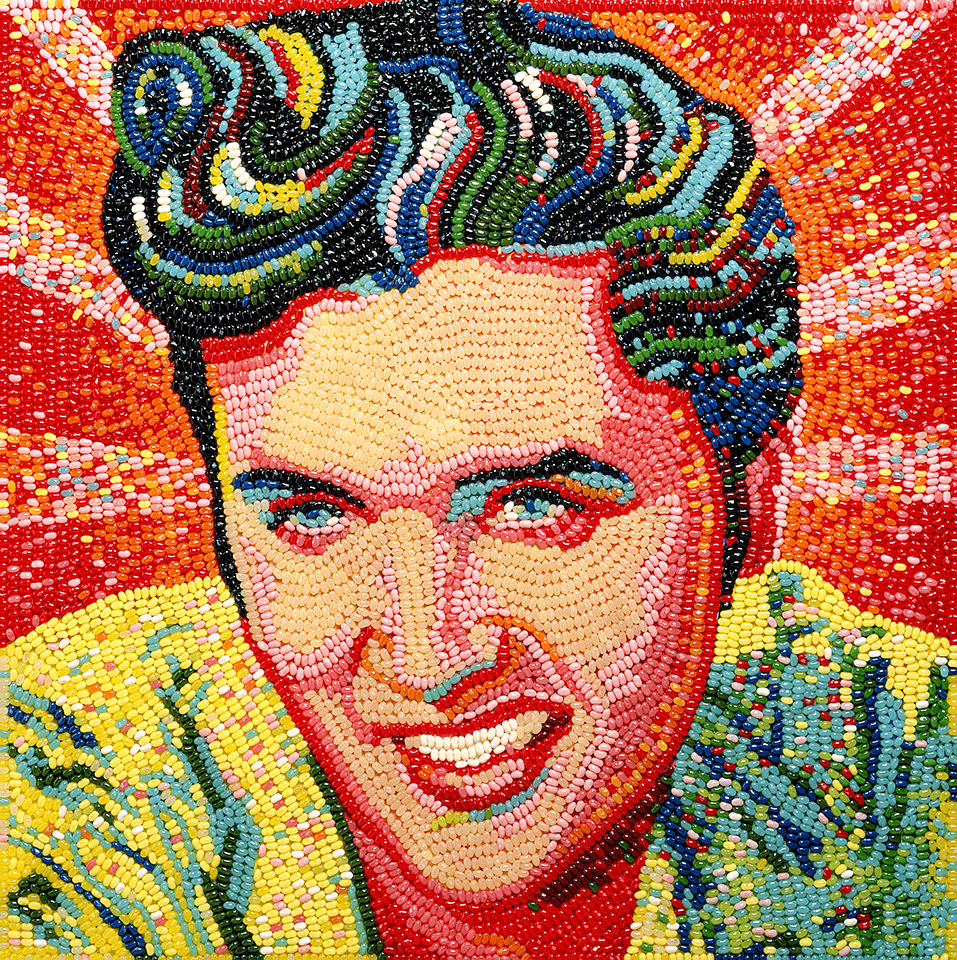
In this portrait, 10 different flavours were used in the King's hair alone!
Elvis Presley 2
Artist: Roger Rocha
Dimensions: 4' x 4'
Main Palette
Bubble Gum
Red Apple
Liquorice
Elvis Presley 3
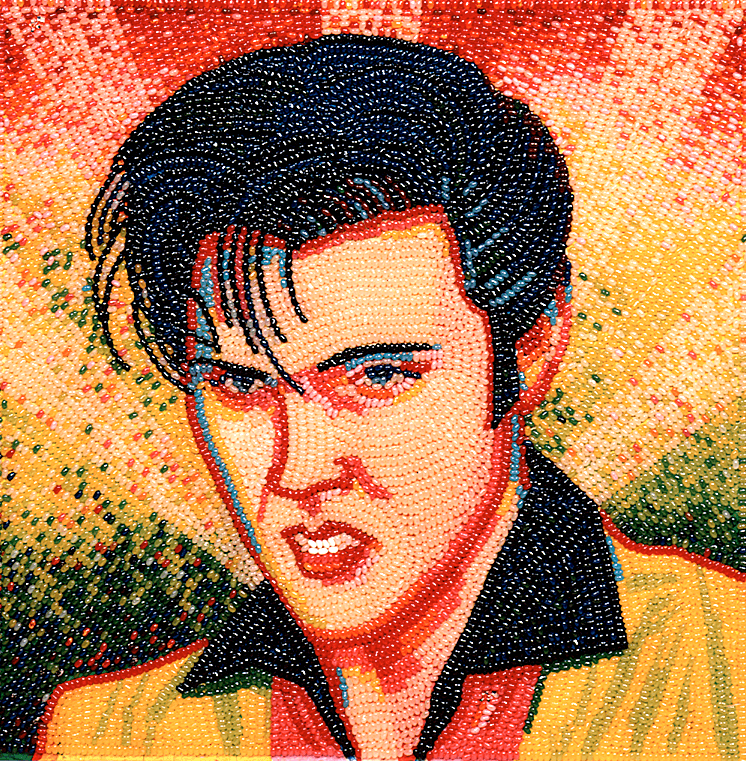
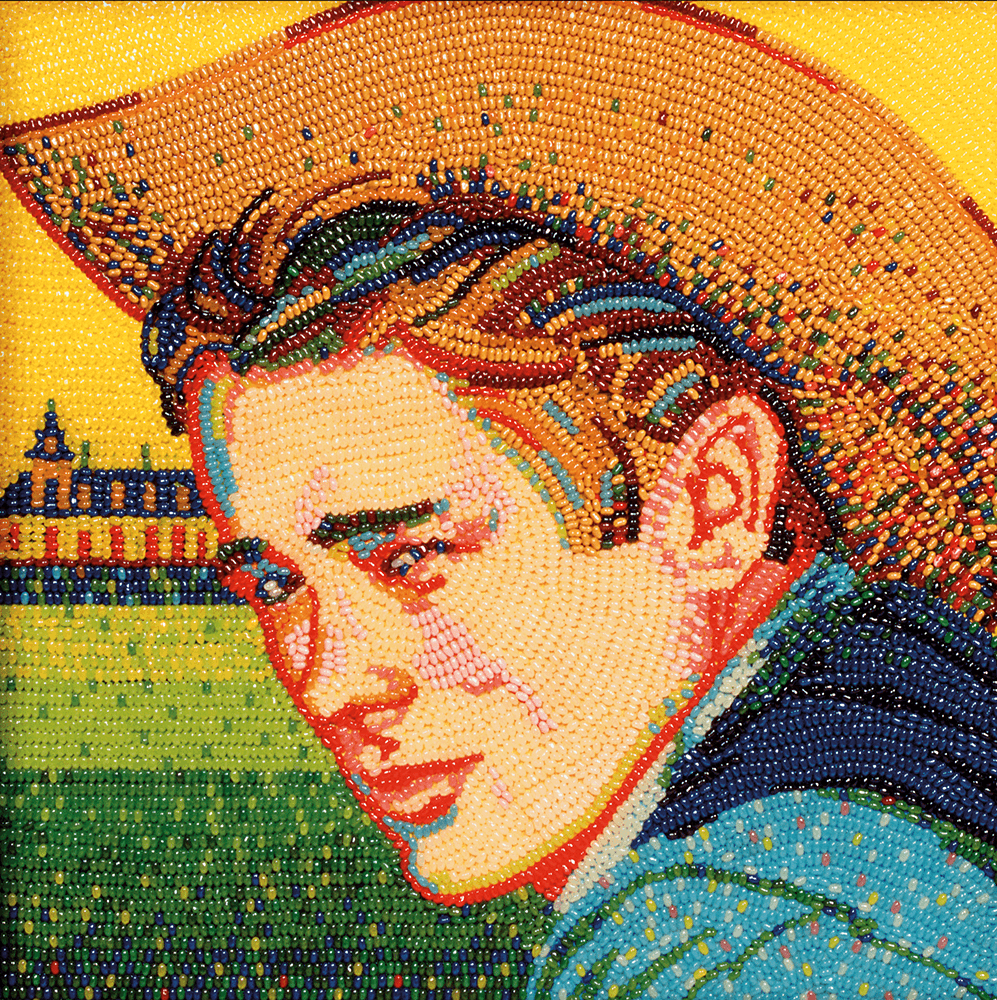
This portrait features a young Elvis in 1956, his breakout year.
Elvis Presley 3
Artist: Roger Rocha
Dimensions: 4' x 4'
Main Palette
Liquorice
Bubble Gum
Coconut
Cotton Candy
Red Apple
Portrait of Herm Rowland
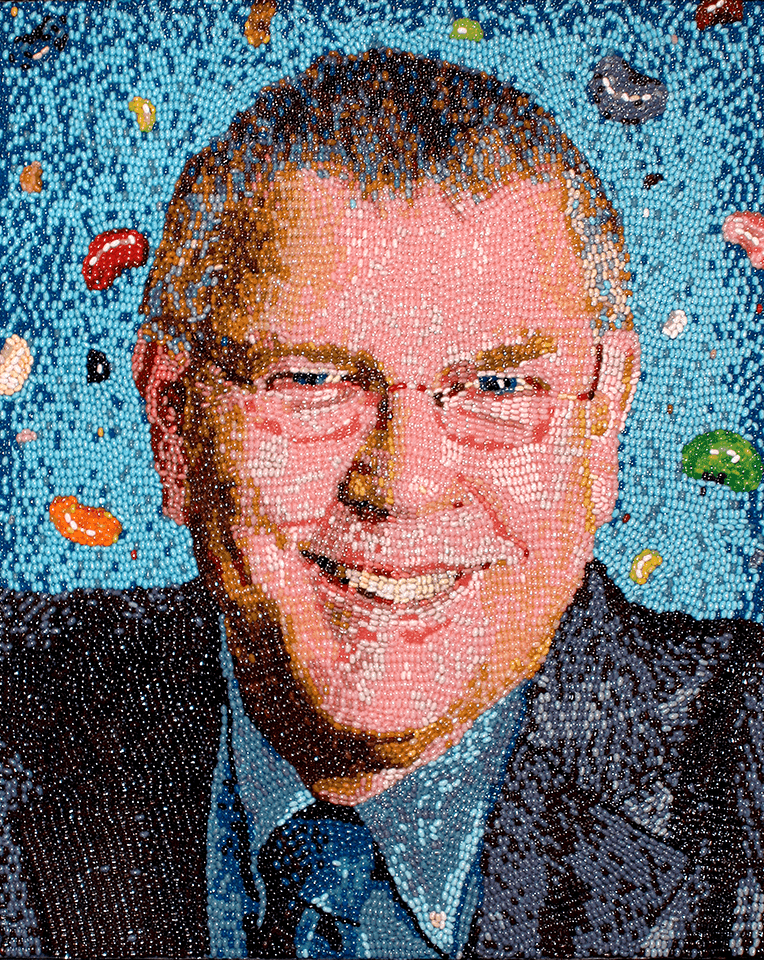
The portrait of Herm Rowland, Sr. was commissioned to honor the Chairman of Bean's 50 years of candy making. The portrait uses all 50 official flavours.
Portrait of Herm Rowland
Artist: Kristen Cumings
Dimensions: 5' x 4'
Main Palette
Bubble Gum
Berry Blue
Liquorice
 Strawberry Cheesecake
James Dean
The legendary actor's portrait was inspired by his 1956 film Giant.
James Dean
Artist: Peter Rocha
Dimensions: 4' x 4'
Main Palette
Berry Blue
Bubble Gum
Laurel & Hardy
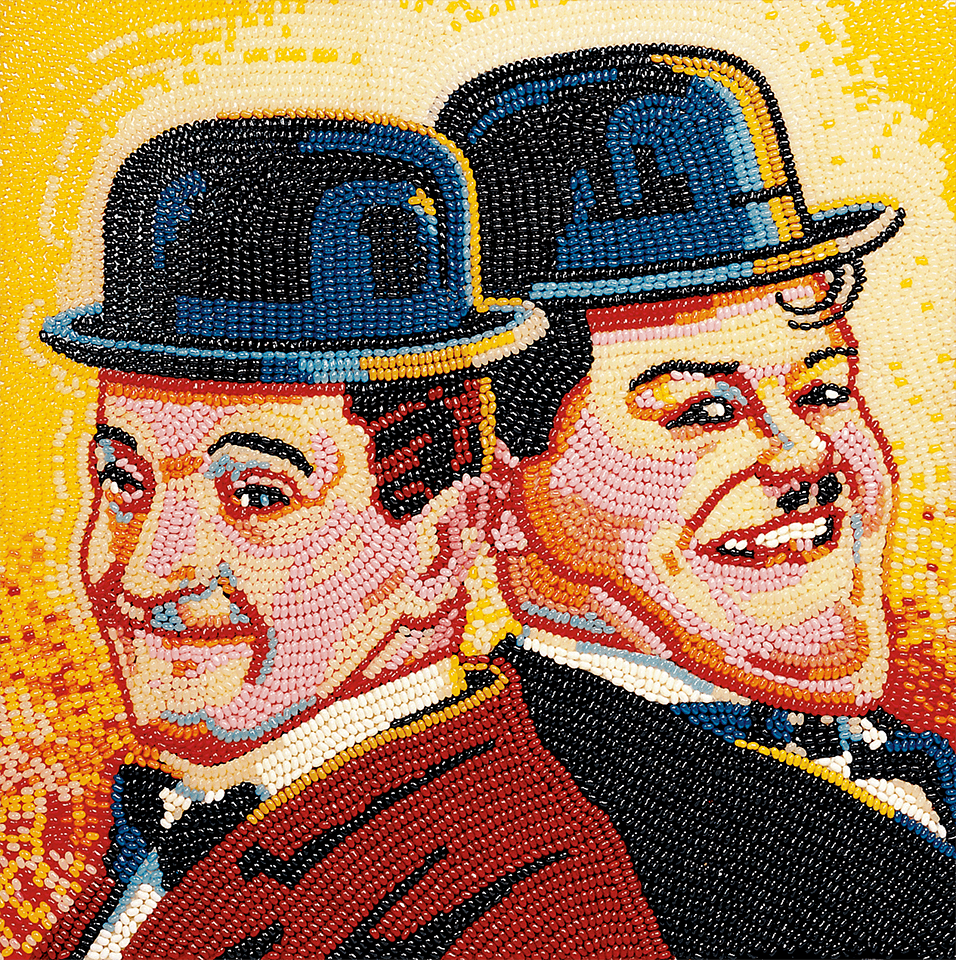
This image of the iconic duo consists primarily of Buttered Popcorn, Bubble Gum, Licorice and Very Cherry flavours.
Laurel & Hardy
Artist: Peter Rocha
Dimensions: 4' x 4'
Main Palette
Buttered Popcorn
Bubble Gum
Liquorice
Very Cherry
The Marriage of HRH Prince William and Kate Middleton
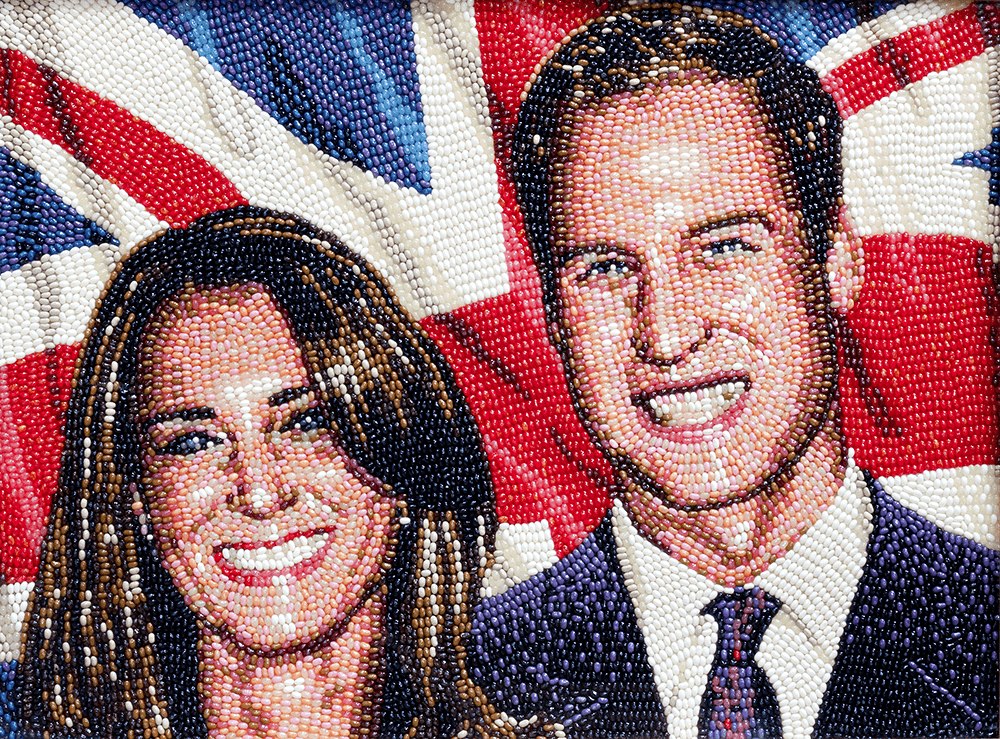
This portrait was created in honor of the marriage of HRH Prince William of Wales and Kate Middleton. The image joins previous portraits of Prince William's grandmother, Queen Elizabeth II, and his mother, Diana, Princess of Wales.
The Marriage of HRH Prince William and Kate Middleton
Artist: Malcolm West
Dimensions: 3.7' x 4.5'
Main Palette
Red Apple
Blueberry
Coconut
Bubble Gum
Her Majesty Queen Elizabeth II
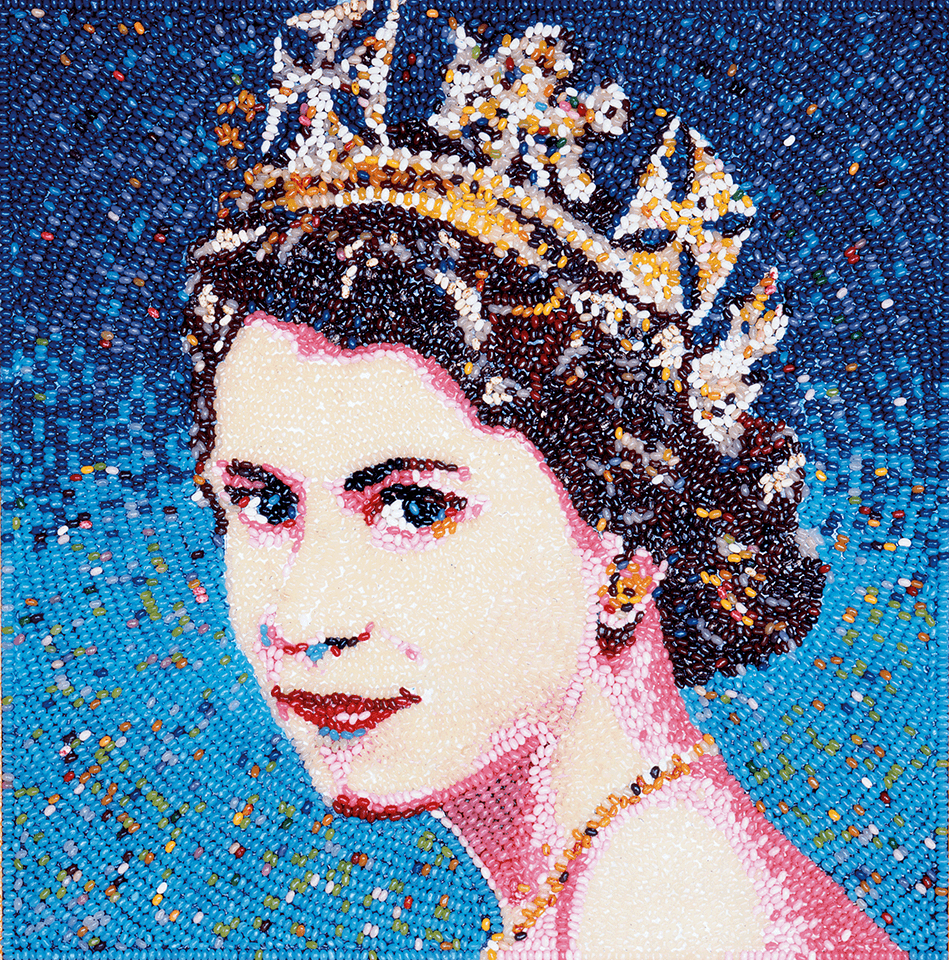
This portrait was commissioned for the 50th anniversary of the queen's reign.
Her Majesty Queen Elizabeth II
Artist: Roger Rocha
Dimensions: 4' x 4'
Main Palette
Blueberry
Berry Blue
Bubble Gum
Red Apple
Margaret Thatcher
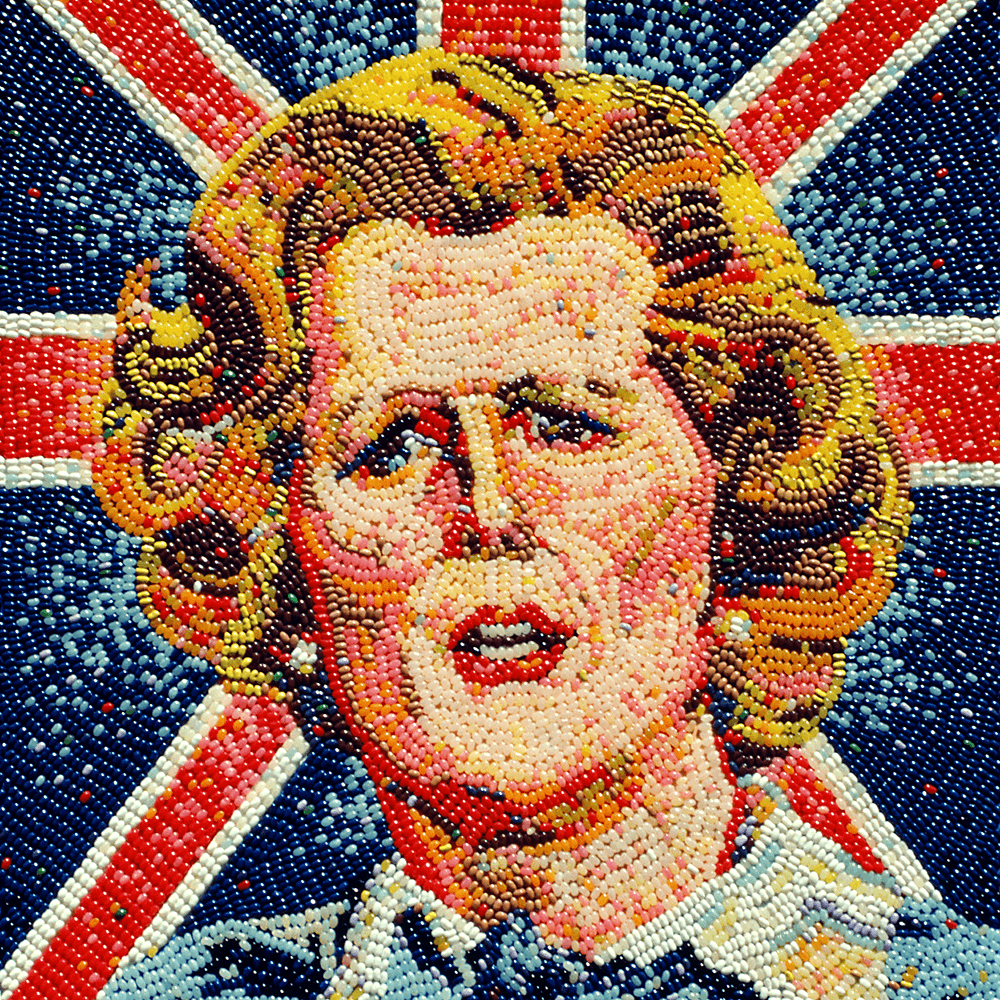
The former Prime Minister of Britain, Margaret Thatcher's portrait consists of over 9,900 beans.
Margaret Thatcher
Artist: Roger Rocha
Dimensions: 4' x 4'
Main Palette
Red Apple
Blueberry
Coconut
Bubble Gum
George H.W. Bush
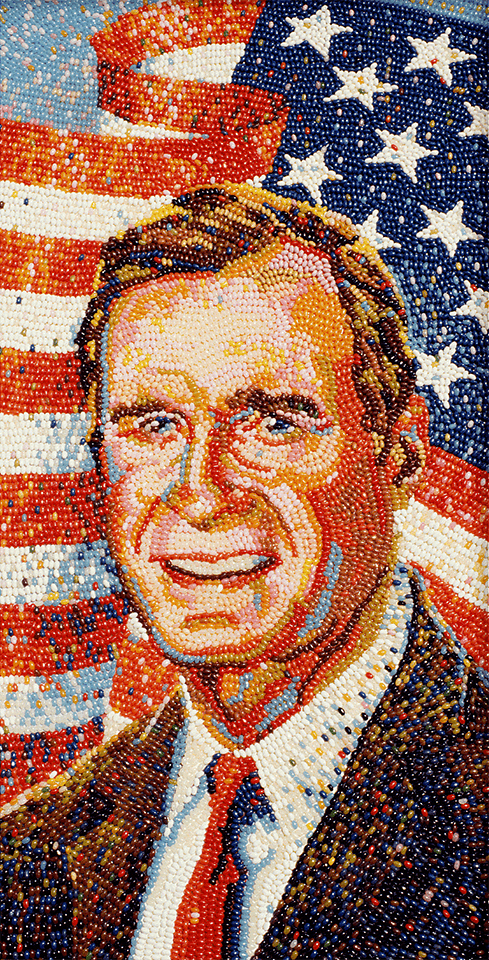
This portrait of the then-vice president was commissioned shortly after the 1984 presidential election.
George H.W. Bush
Artist: Peter Rocha
Dimensions: 6' x 4'
Main Palette
Blueberry
Red Apple
 Pink Grapefruit
Coconut
Cotton Candy
Pink Grapefruit
Coconut
Cotton Candy
'Spirit of 1776' Fife Player
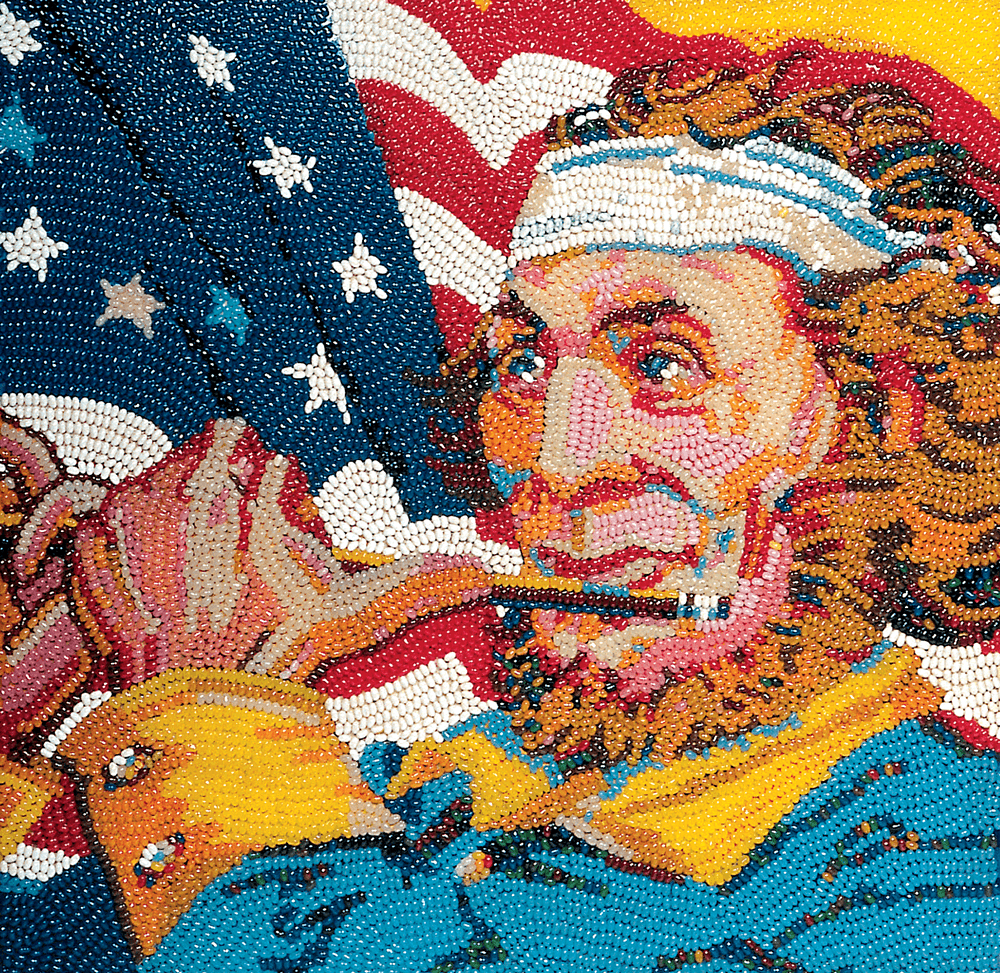
This slice of colonial Americana consists of just over 10,000 beans and more than 20 flavours.
'Spirit of 1776' Fife Player
Artist: Peter Rocha
Dimensions: 4' x 4'
Main Palette
Lemon
Blueberry
Red Apple
Coconut
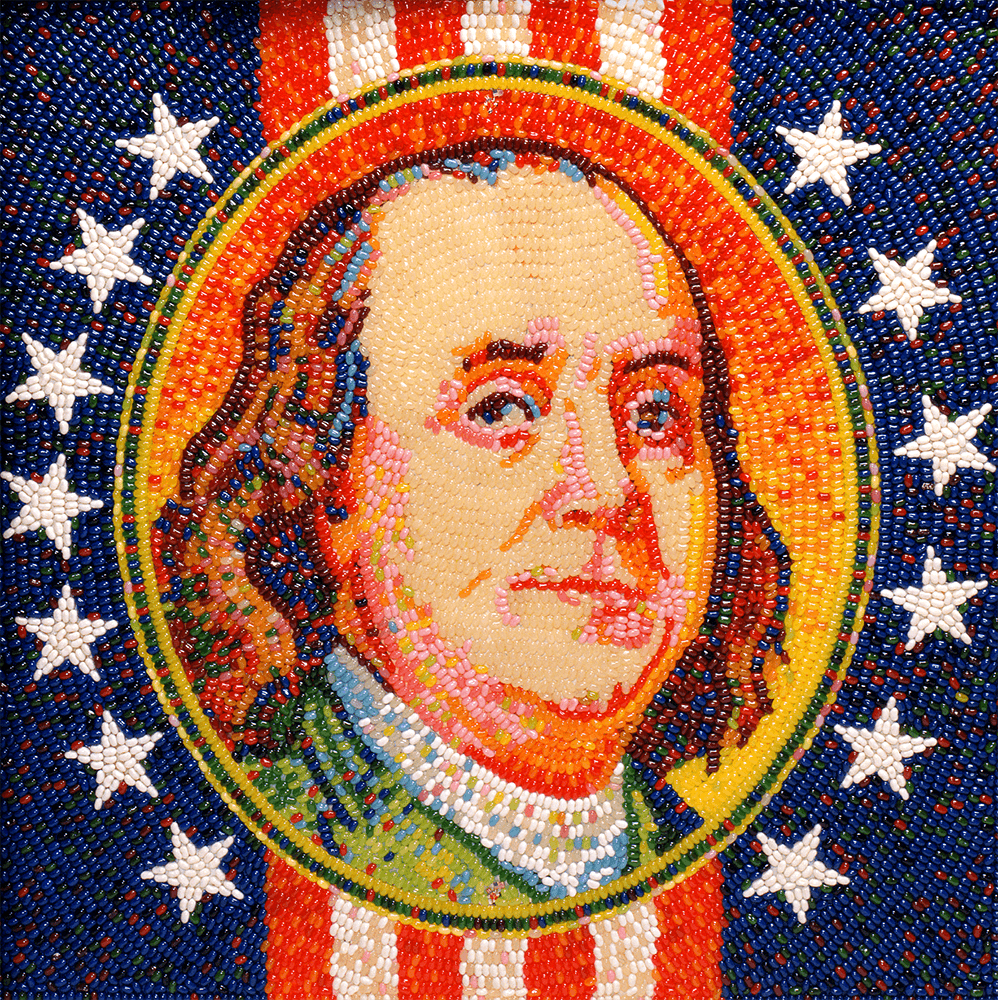
Benjamin Franklin
The primarily Blueberry background of this work has Very Cherry and Kiwi flavours scattered in it to create a more vibrant, shiny appearance.
Benjamin Franklin
Artist: Peter Rocha
Dimensions: 4' x 4'
Main Palette
Blueberry
Coconut
Very Cherry
 Kiwi
Bubble Gum
Kiwi
Bubble Gum
Martin Luther King, Jr.
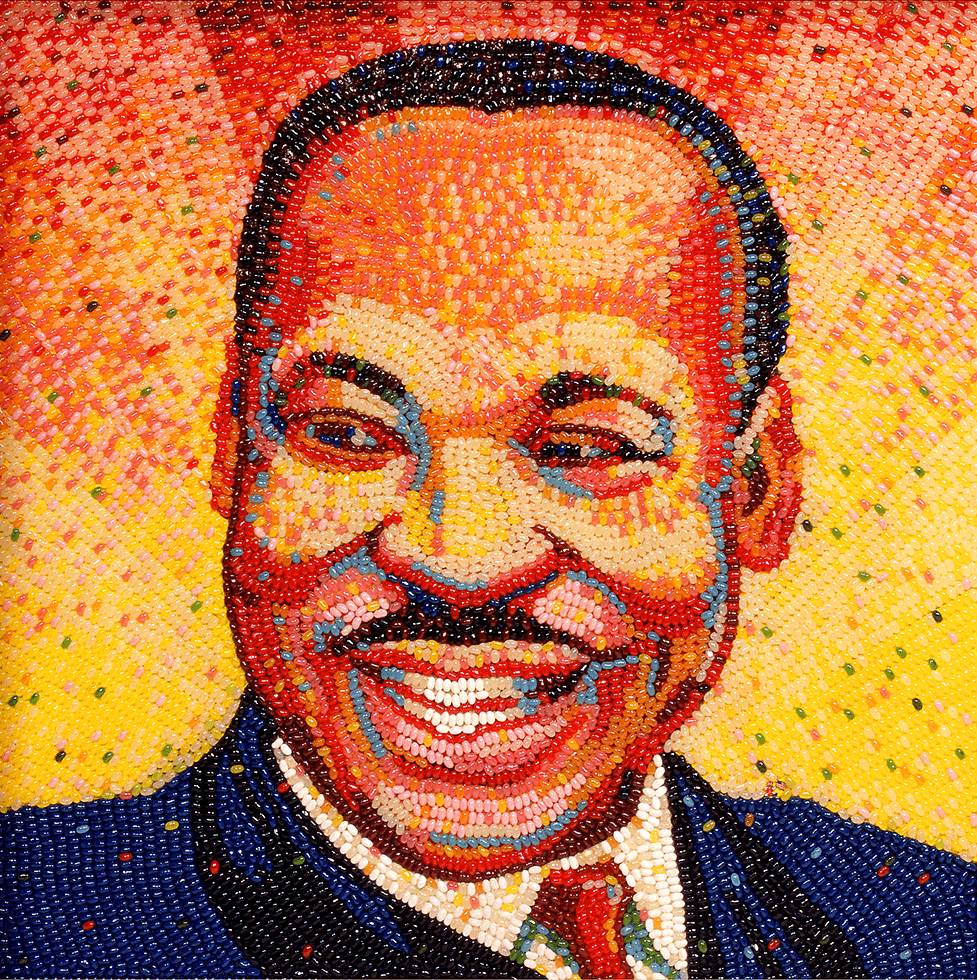
To honor the life and accomplishments of the late civil rights leader, Martin Luther King, Jr., this mosaic was commissioned by the company at the suggestion of the company's employees.
Martin Luther King, Jr.
Artist: Peter Rocha
Dimensions: 4' x 4'
Main Palette
Liquorice
Blueberry
Pink Grapefruit
Abraham Lincoln
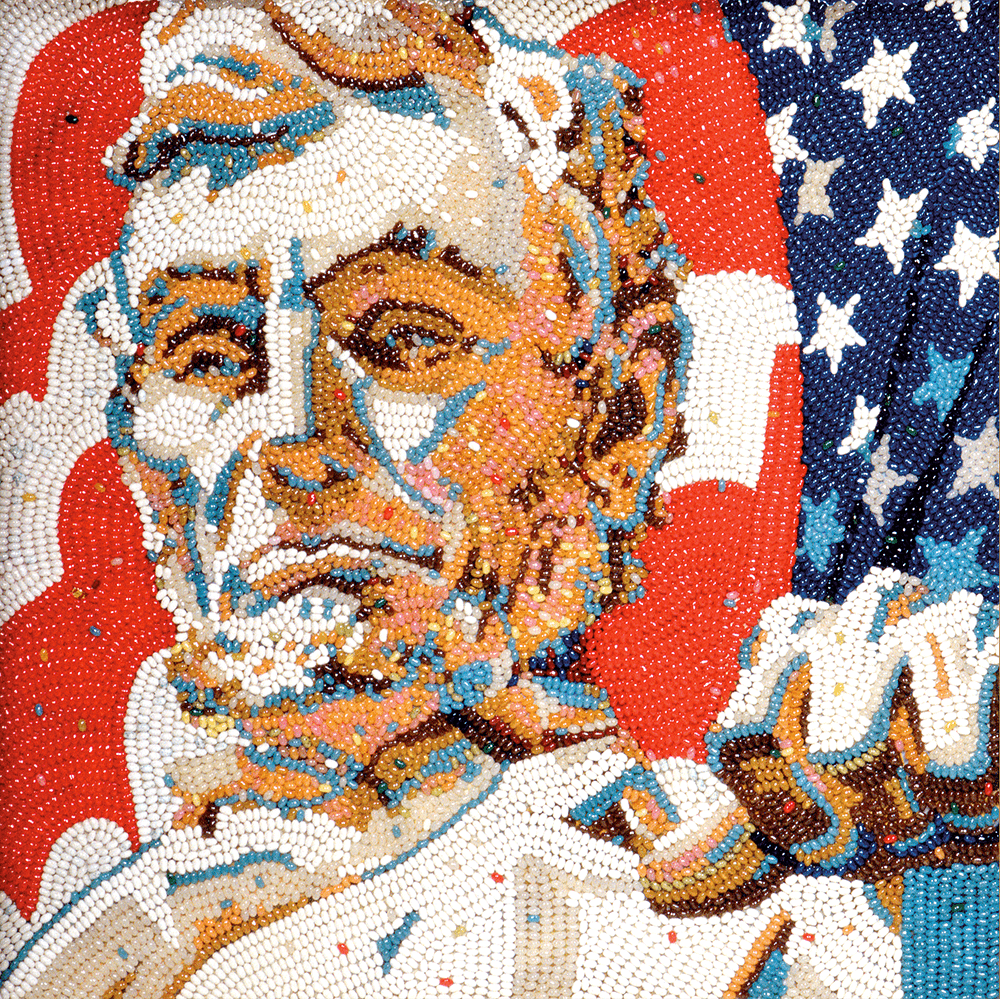
This portrait of the 16th US president, inspired by the Lincoln Memorial, was unveiled in the Illinois Governor's Office.
Abraham Lincoln
Artist: Peter Rocha
Dimensions: 4' x 4'
Main Palette
Coconut
Very Cherry
Blueberry
President & Mrs. Reagan
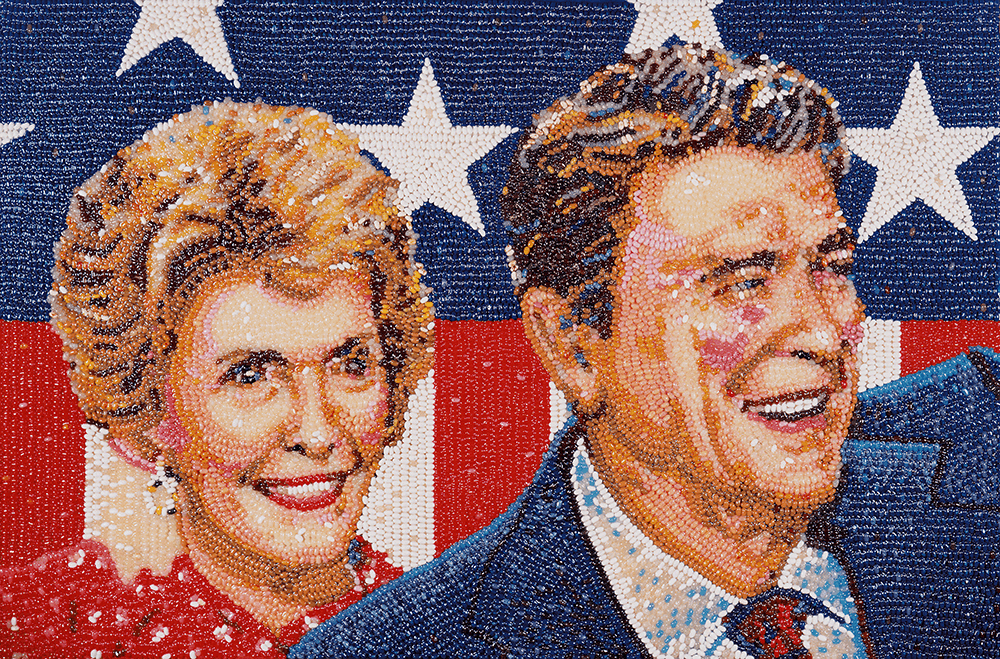
Based on the iconic photo of President Reagan and the First Lade from the 1984 election season, this is the only Jelly Belly Art piece in our collection that includes them both. It was displayed at the Ronald Reagan Presidential Library in November 2010 and now resides at the Jelly Belly Visitor Center in California.
President & Mrs. Reagan
Artist: Roger Rocha
Dimensions: 4' x 6'
Main Palette
Blueberry
Coconut
Very Cherry
Bubble Gum
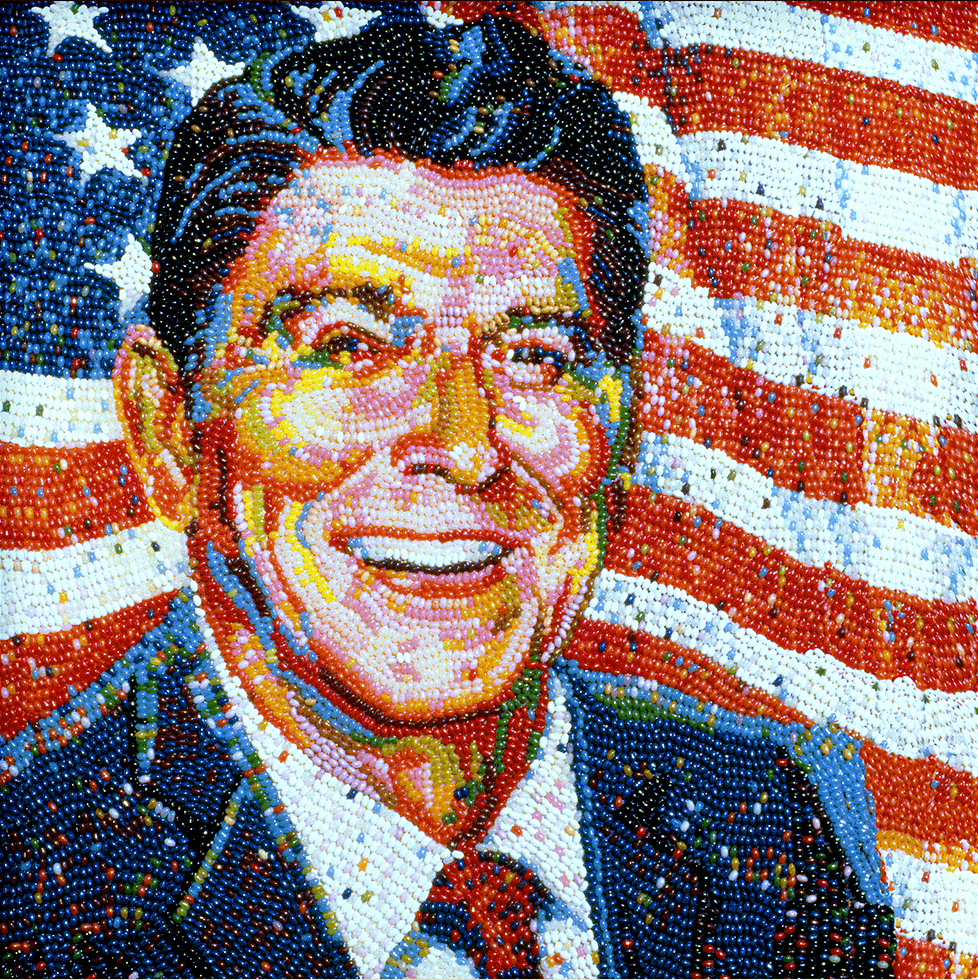
Ronald Reagan
This portrait resides at the Reagan Library in Simi Valley, California.
Ronald Reagan
Artist: Peter Rocha
Dimensions: 4' x 4'
Main Palette
 Wild Blackbery
Red Apple
Lemon
Coconut
Bubble Gum
Wild Blackbery
Red Apple
Lemon
Coconut
Bubble Gum
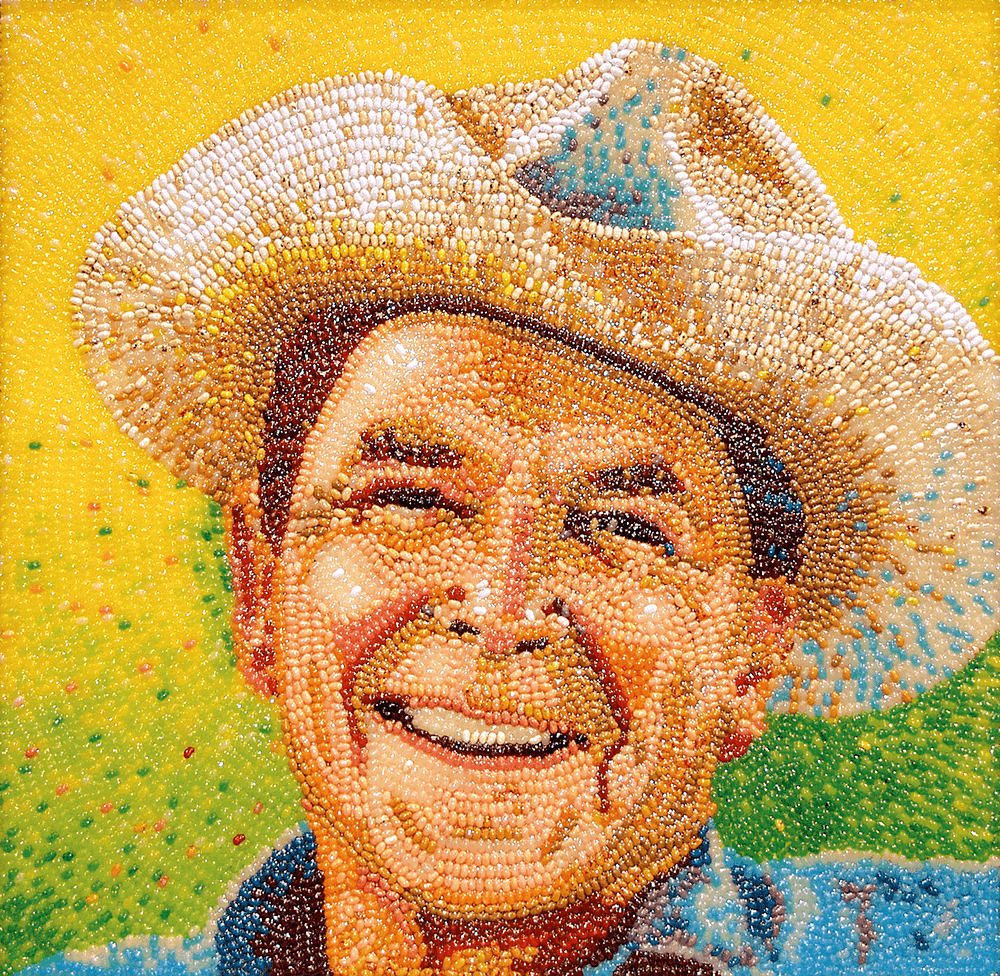
Reagan Country
One of the most popular pieces of Jelly Belly Art, this portrait of President Ronald Reagan was inspired by his love for horseback riding at his California ranch.
Reagan Country
Artist: Roger Rocha
Dimensions: 4' x 4'
Main Palette
Lemon
Lemon Lime
Coconut
Pink Grapefruit
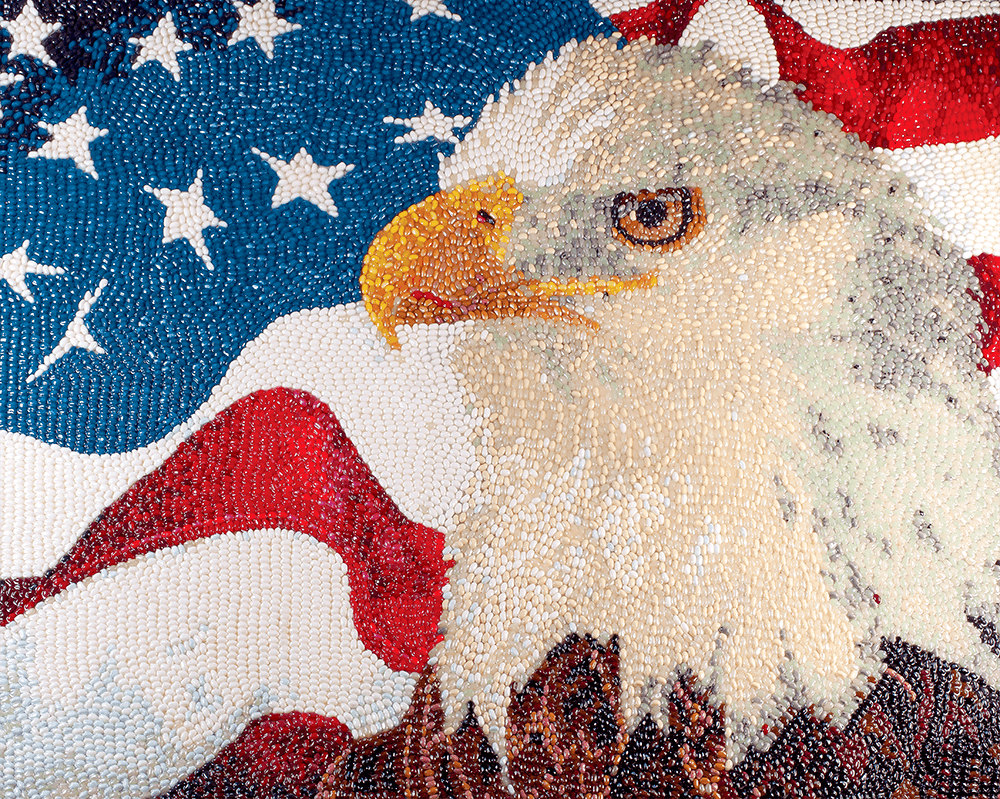
American Bald Eagle
The white in the bald eagle's head consists mainly of Coconut flavoured beans, shaded with A&W® Cream Soda and Berry Blue.
American Bald Eagle
Artist: Peter Rocha
Dimensions: 4' x 4'
Main Palette
Coconut
Lemon
Blueberry
Very Cherry
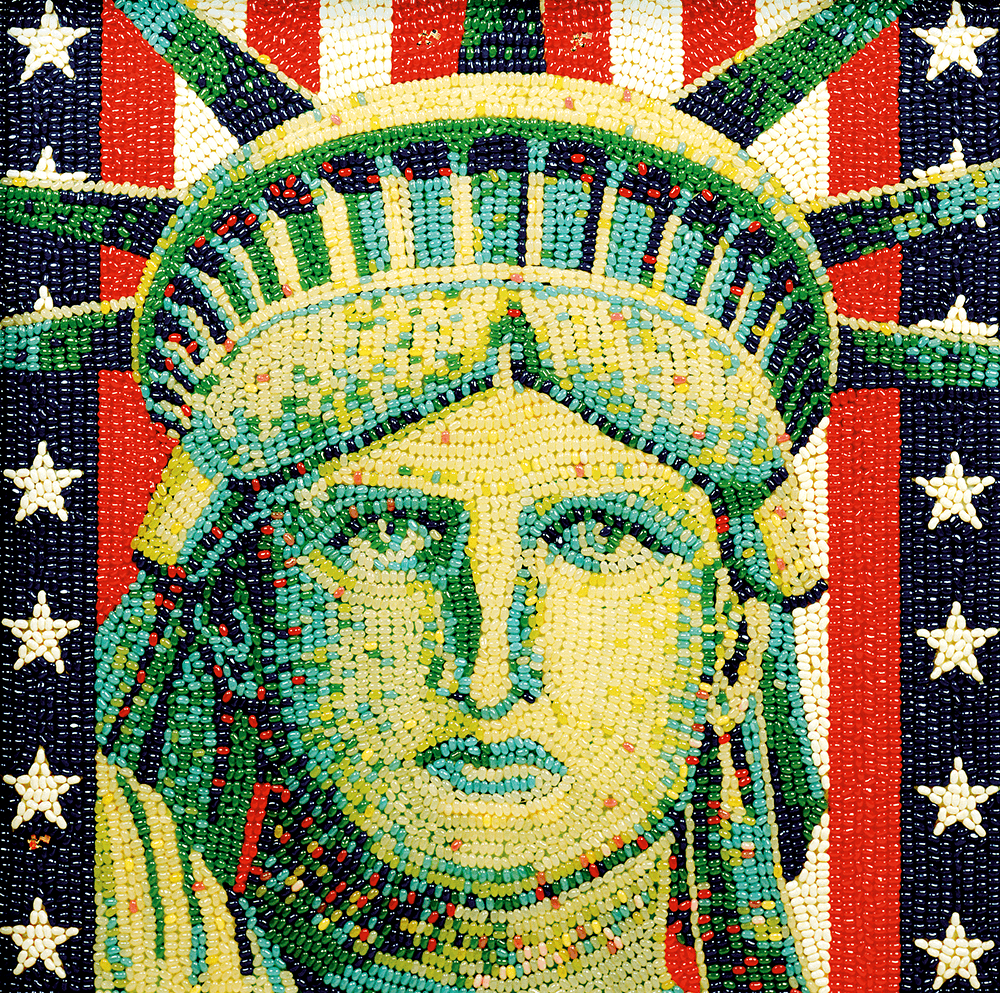
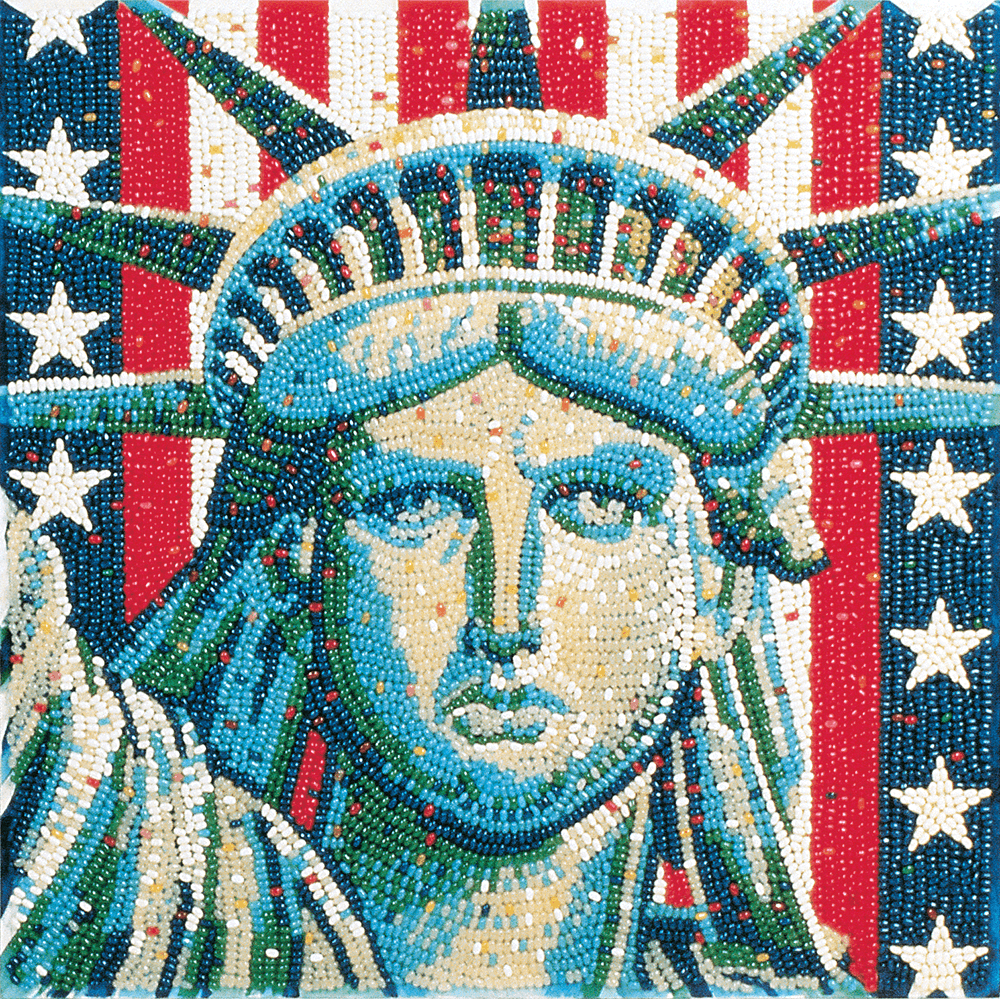
Statue of Liberty
The primary flavours used to create the Statue were Green Apple, Lemon Lime, Berry Blue, Lemon and Buttered Popcorn.
Statue of Liberty
Artist: Peter Rocha
Dimensions: 6' x 4'
Main Palette
Green Apple
Lemon Lime
Berry Blue
Lemon
Buttered Popcorn
Statue of Liberty 2
This portrait, made of almost 14,000 beans, is featured in the American Crafts Museum national tour.
Statue of Liberty 2
Artist: Peter Rocha
Dimensions: 4' x 4'
Main Palette
Blueberry
Very Cherry
Coconut
Green Apple
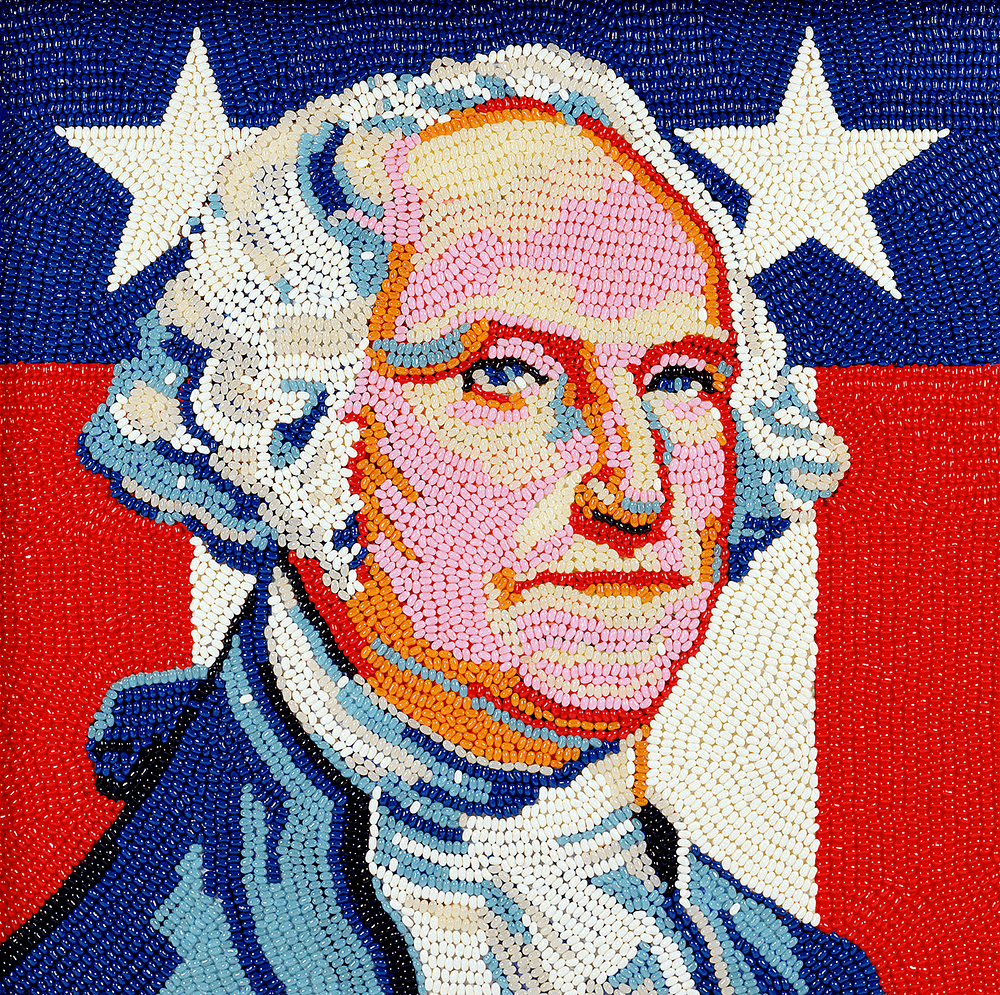
George Washington
This portrait of the first US president was unveiled in the Virginia Governor's Office and shown at the Seattle Art Museum.
George Washington
Artist: Peter Rocha
Dimensions: 4' x 4'
Main Palette
Blueberry
Coconut
Very Cherry
Bubble Gum
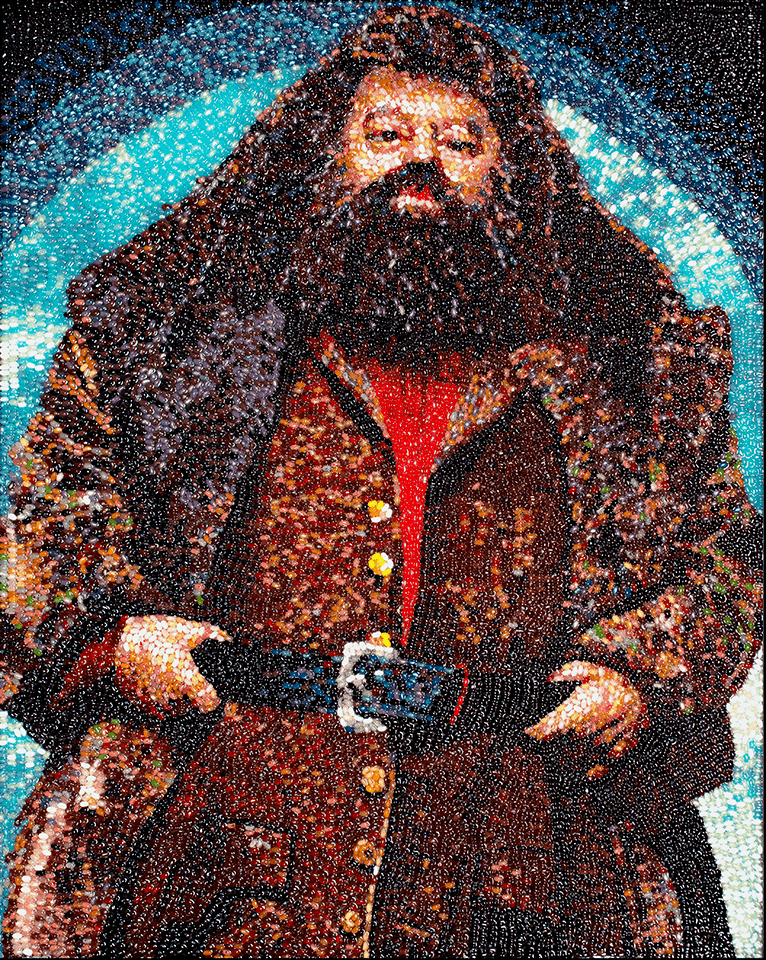
Hagrid
Hagrid
Artist: Kristen Cumings
Dimensions: 4' x 5'
Main Palette
Cappuccino
Wild Blackbery
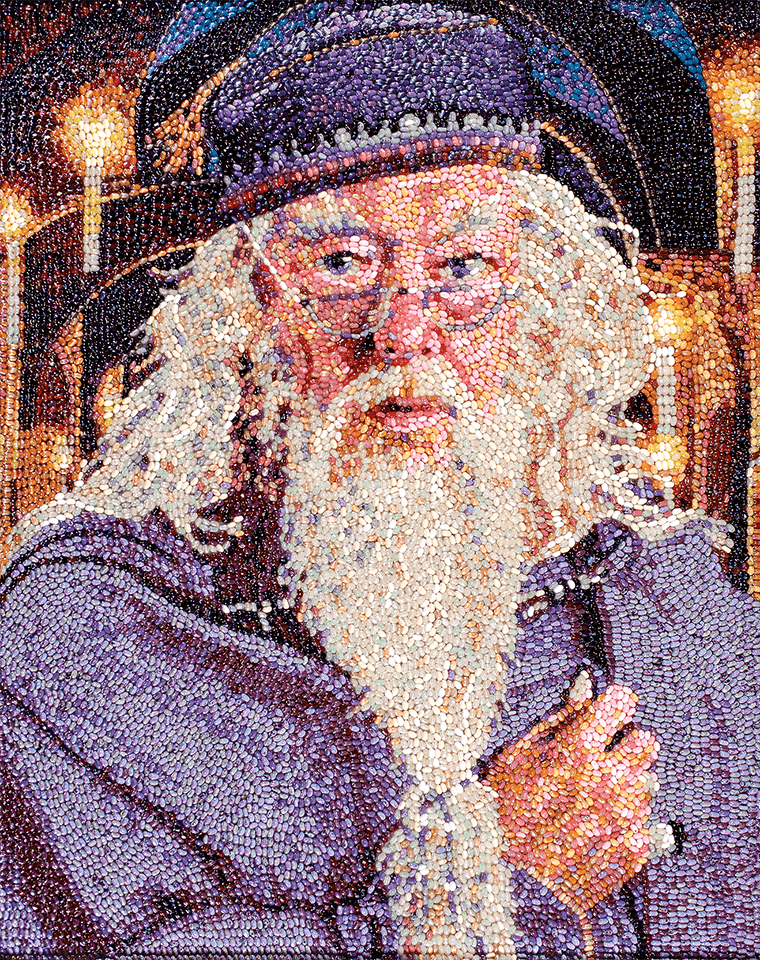
Albus Dumbledore
This portrait of the headmaster of Hogwarts is forged from more than 12,000 Jelly Belly jelly beans. It was created at the San Diego County Fair in 2018, and was completed in less than four days. Jelly Belly bean flavors found in this piece include Coconut, Jewel Cream Soda and Mixed Berry Smoothie. The finished work also includes non-traditional flavors from Harry Potter Bertie Bott’s Every Flavour Beans such as Black Pepper, Earwax, Soap, and Sausage.
Albus Dumbledore
Artist: Kristen Cumings
Dimensions: 4' x 5'
Main Palette
Coconut
 Mixed Berry Smoothie
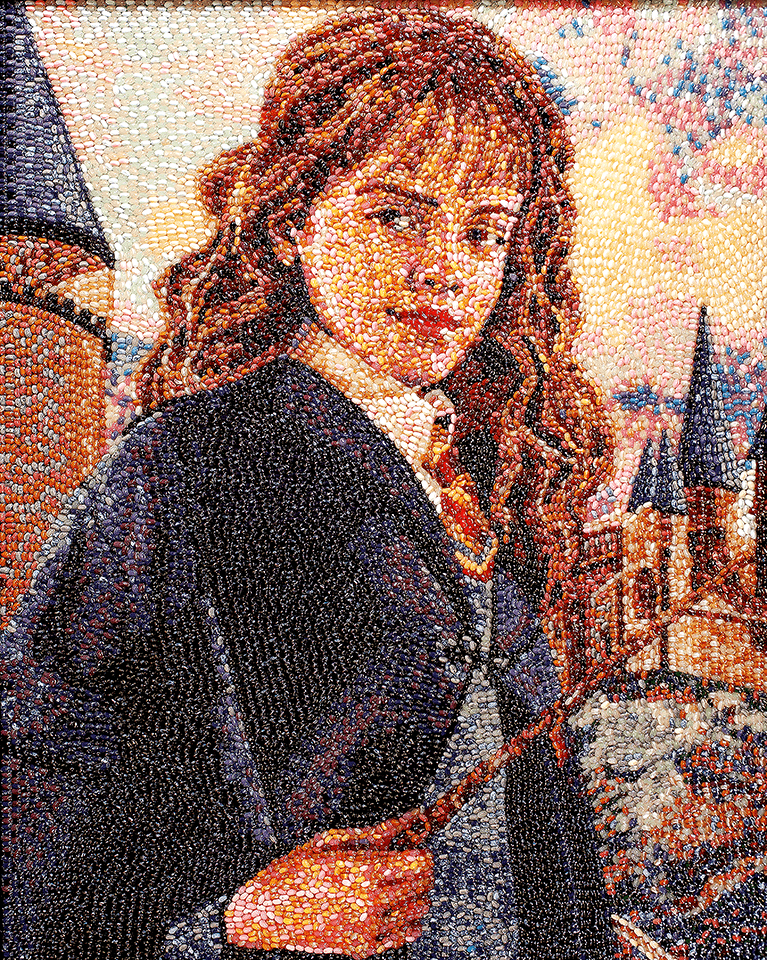
Hermoine Granger
Created at the Emerald City Comic Con in 2019 this portrait of Hermione Granger is made of more than 12,000 Jelly Belly jelly beans. Flavors used include bubble gum, licorice, maple syrup and Bertie Bott’s Every Flavour Beans such as soap and sausage
Hermoine Granger
Artist: Kristen Cumings
Dimensions: 4' x 5'
Main Palette
Bubble Gum
Liquorice
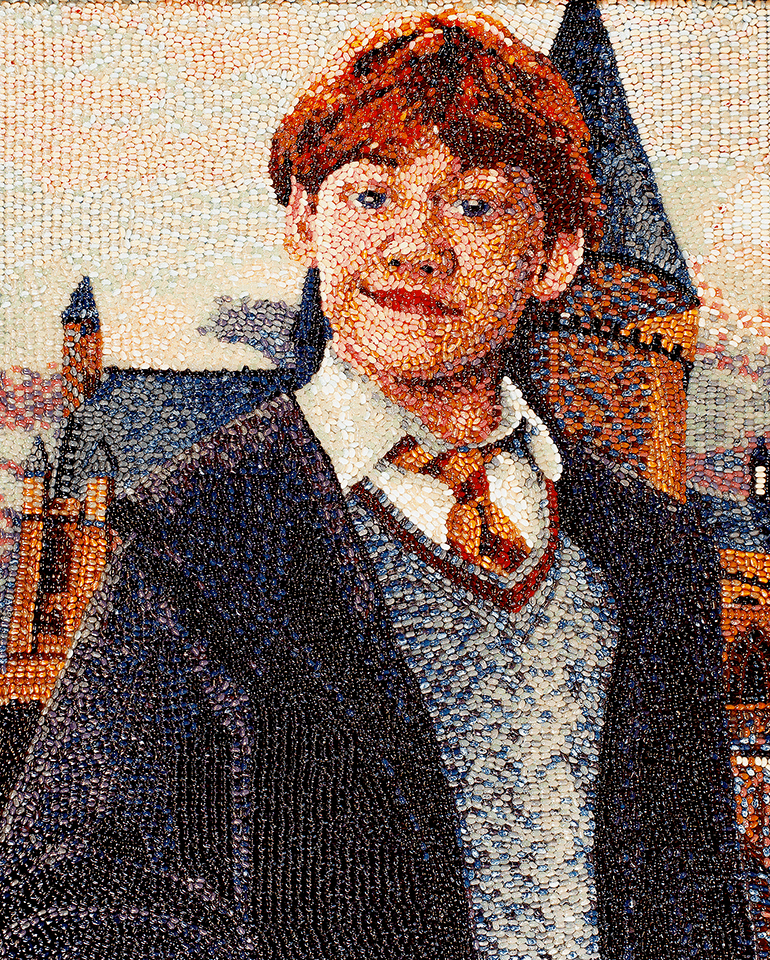
Ron Weasley
This portrait of Ron Weasley, took four days to complete. It is made up of more than 12,000 Jelly Belly jelly beans and the finished work includes non-traditional flavors from Harry Potter Bertie Bott’s Every Flavour Beans such as Black Pepper, Earwax, Soap, and Sausage. Some Jelly Belly bean flavors found in this piece include Jewel Cream Soda, Strawberry Daquiri, and Plum.
Ron Weasley
Artist: Kristen Cumings
Dimensions: 4' x 5'
Main Palette
 Jewel Cream Soda
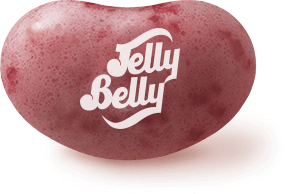 Strawberry Daiquiri
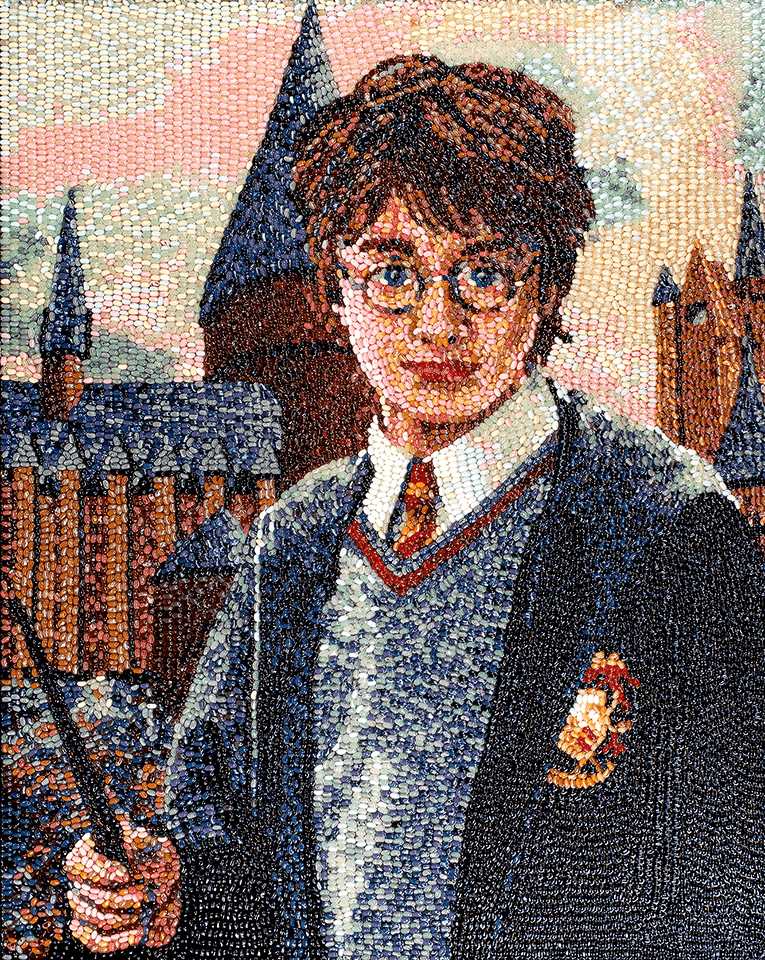
Harry Potter
Created at New York City Comic Con in 2018, artist in residence Kristen Cumings used more than 12,000 Jelly Belly jelly beans on this portrait of Harry Potter. Jelly Belly bean flavors found in this piece include Chili Mango, Cappuccino and Strawberry Cheesecake. The finished work also includes non-traditional flavors from Harry Potter Bertie Bott’s Every Flavour Beans.
Harry Potter
Artist: Kristen Cumings
Dimensions: 4' x 5'
Main Palette
Cappuccino
Strawberry Cheesecake
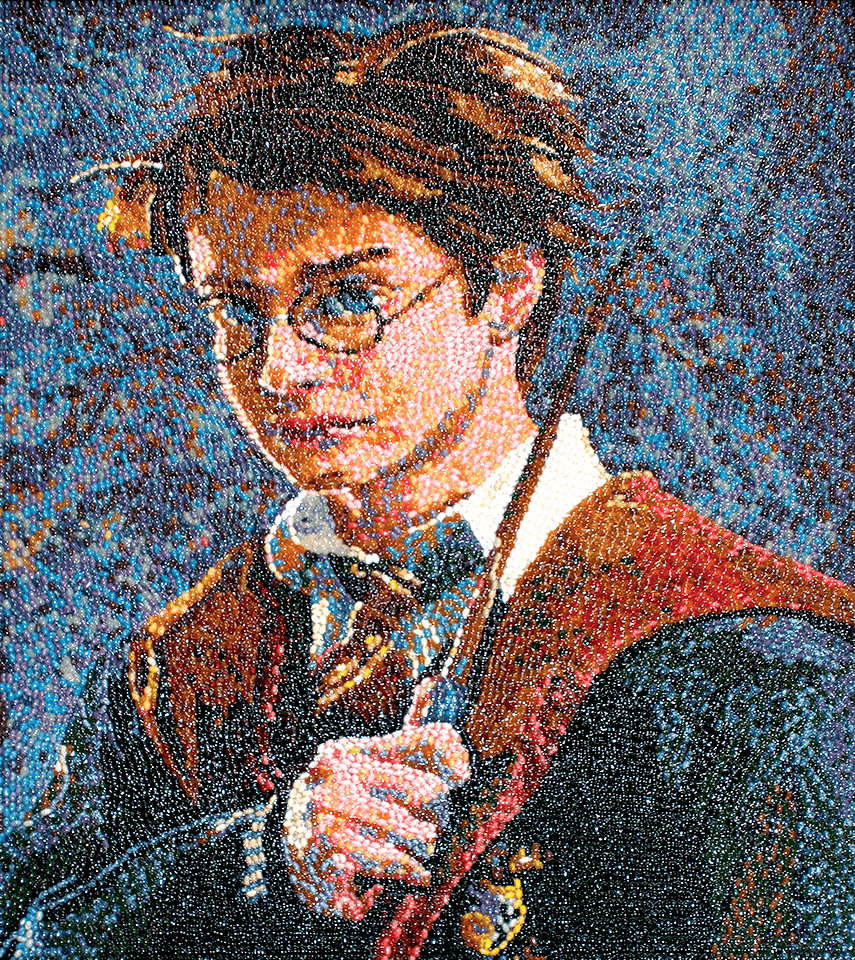
Harry Potter
This portrait of Harry Potter used 11,000 Jelly Belly beans in honor of Bertie Bott's Every Flavour Beans® Made by Jelly Belly. This fictional confection now brought to the Muggle-world includes original flavours such as Earwax, Booger and Dirt. The piece can be viewed at Jelly Belly Visitor Center in Fairfield, California.
Harry Potter
Artist: Kristen Cumings
Dimensions: 5' x 4'
Main Palette
Liquorice
DC Wonder Woman
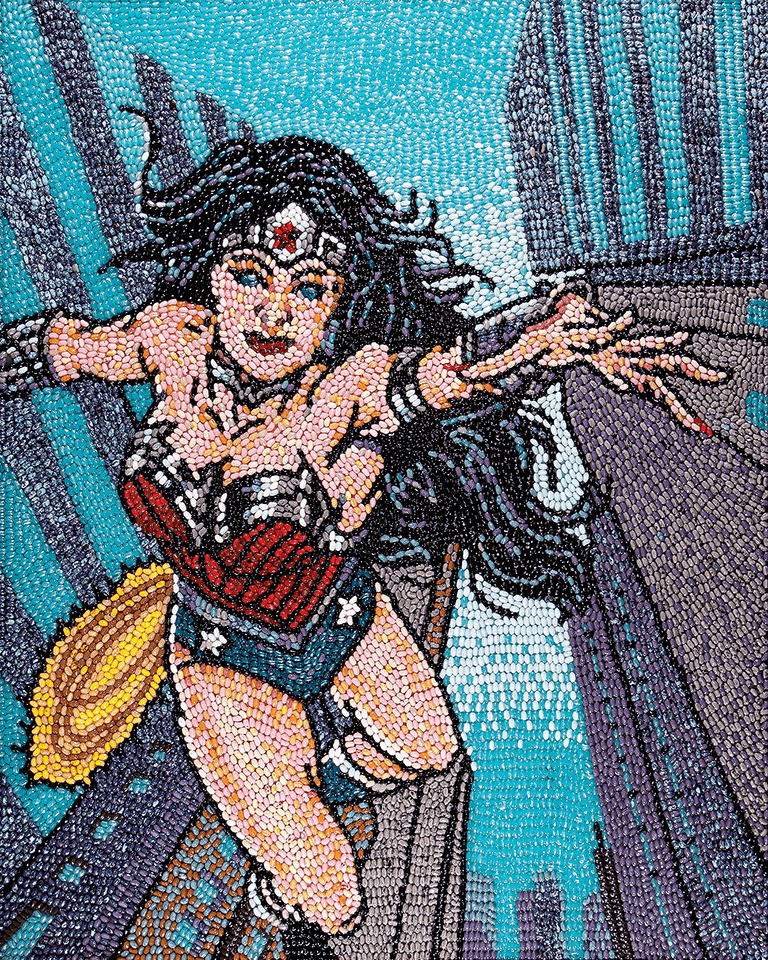
Jelly Belly artist in residence Kristen Cumings created a portrait of DC WONDER WOMAN™ in 2016 at New York Comic Con with more than 180,000 attendees watching her work throughout the convention. Made of around 12,000 Jelly Belly jelly beans such as Caramel Corn, Jewel Ginger Ale, and Pancakes and Maple Syrup, this work of art now resides in the company’s private collection.
DC Wonder Woman
Artist: Kristen Cumings
Dimensions: 4' x 5'
Main Palette
Berry Blue
Strawberry Cheesecake
Lemon
Coconut
DC Superman
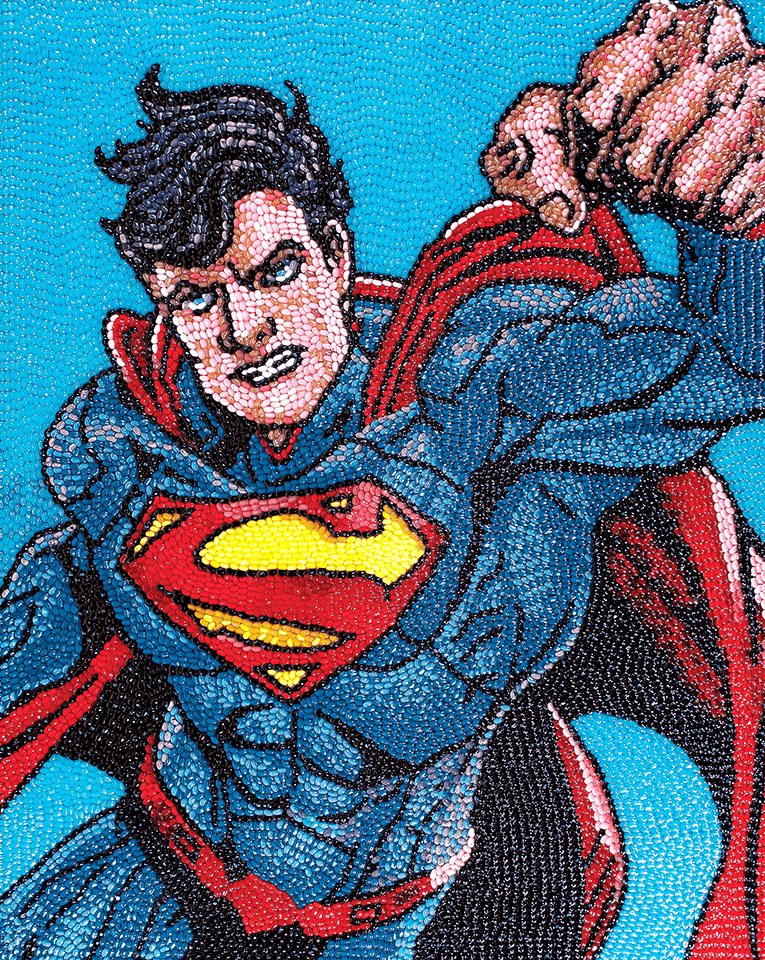
Working in front of a live audience at Chicago Comic and Entertainment Expo in 2016, artist in residence Kristen Cumings used around 12,000 Jelly Belly jelly beans to complete this SUPERMAN™ mosaic. Cumings brought this portrait of SUPERMAN to life by choosing a variety of flavors from Very Cherry and Strawberry Cheesecake to Jewel Ginger Ale and Jewel Blueberry. This colorful mosaic is now in the company’s permanent collection.
DC Superman
Artist: Kristen Cumings
Dimensions: 4' x 5'
Main Palette
Very Cherry
Strawberry Cheesecake
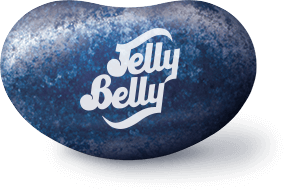 Jewel Blueberry
DC Batman
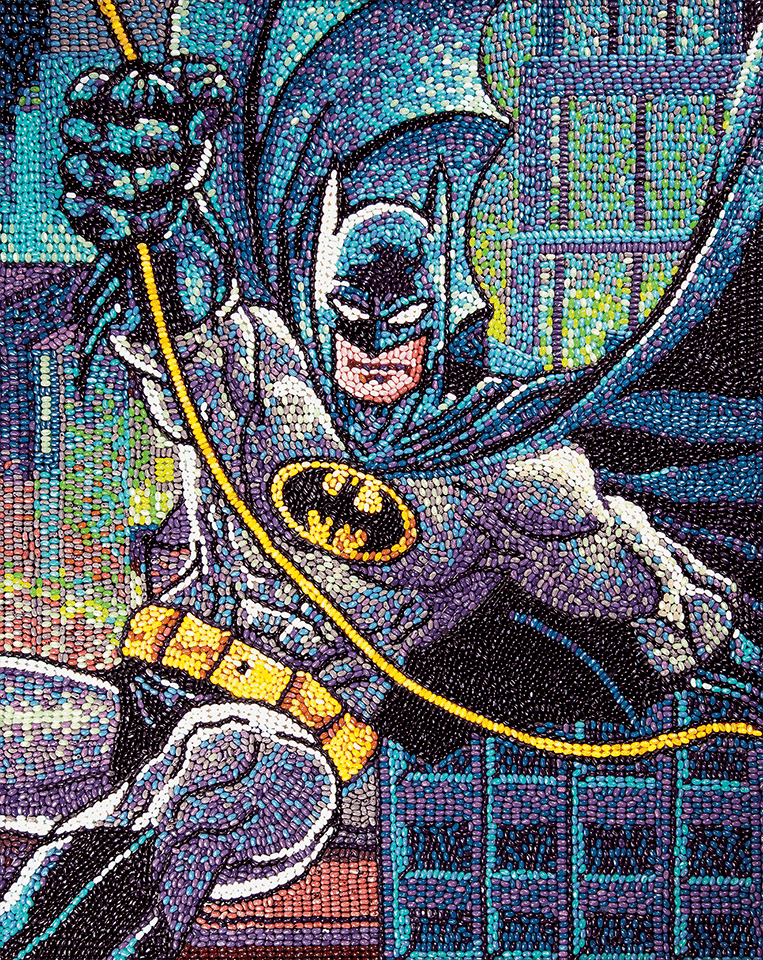
Using more than 12,000 Jelly Belly jelly beans, this mosaic of BATMANâ„¢ is made from Jelly Belly bean flavors such as Buttered Popcorn, Plum, Blueberry and Berry Blue. Artist Kristen Cumings created the work during New York Comic Con in 2015 with more than 160,000 attendees watching her work over the span of the convention. The mosaic now resides alongside other bean art pieces in the private collection of Jelly Belly Art.
DC Batman
Artist: Kristen Cumings
Dimensions: 4' x 5'
Main Palette
Berry Blue
Liquorice
Jewel Blueberry
Santa Claus
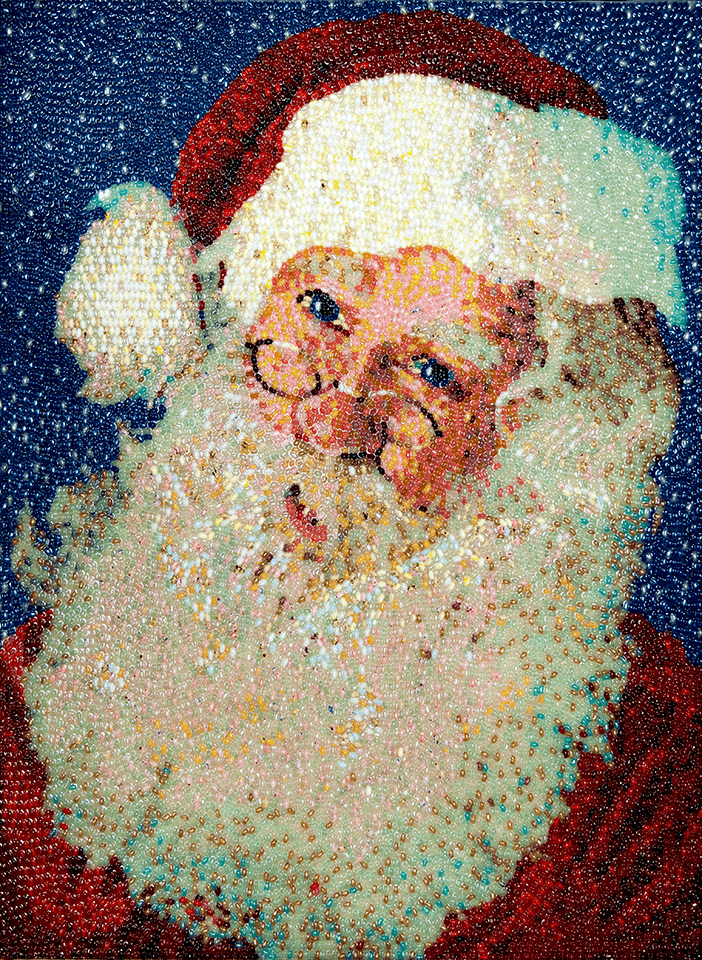
This sweet Santa Claus portrait is made with more than 10,000 Jelly Belly® jelly beans each lovingly placed by hand. Santa has a Blueberry twinkle in his eye and jolly red velvet suit made of Very Cherry, Red Apple and even Strawberry Jam Jelly Belly beans! The big man joins the private collection of Jelly Belly Art, a colourful and larger-than life collection of art pieces made completely out of Jelly Belly jelly beans.
Santa Claus
Artist: Kristen Cumings
Dimensions: 5’ x 4’
Main Palette
Blueberry
Coconut
Bubble Gum
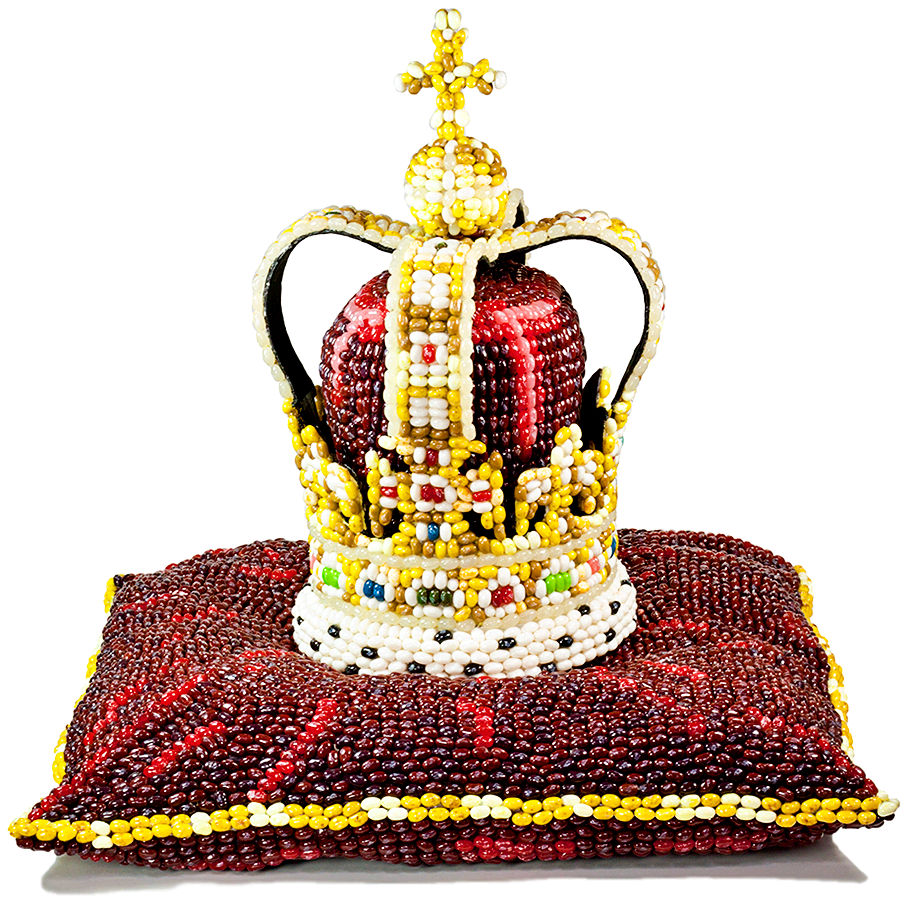
The Crown Jewels
A sweet reproduction of the St. Edward's Crown is a scrumptious look-a-like of the crown that was used for HM Queen Elizabeth II coronation in 1953. The 3D Jelly Belly sculpture was commissioned for the Queen's Diamond Jubilee of 2012.
The Crown Jewels
Artist: Malcolm West
Dimensions: 1' wide, sits on a 1.5' cushion
Main Palette
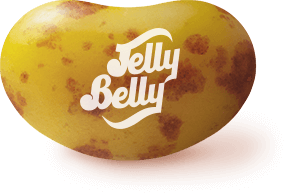 Top Banana
Very Cherry
Coconut
Liquorice
Top Banana
Very Cherry
Coconut
Liquorice
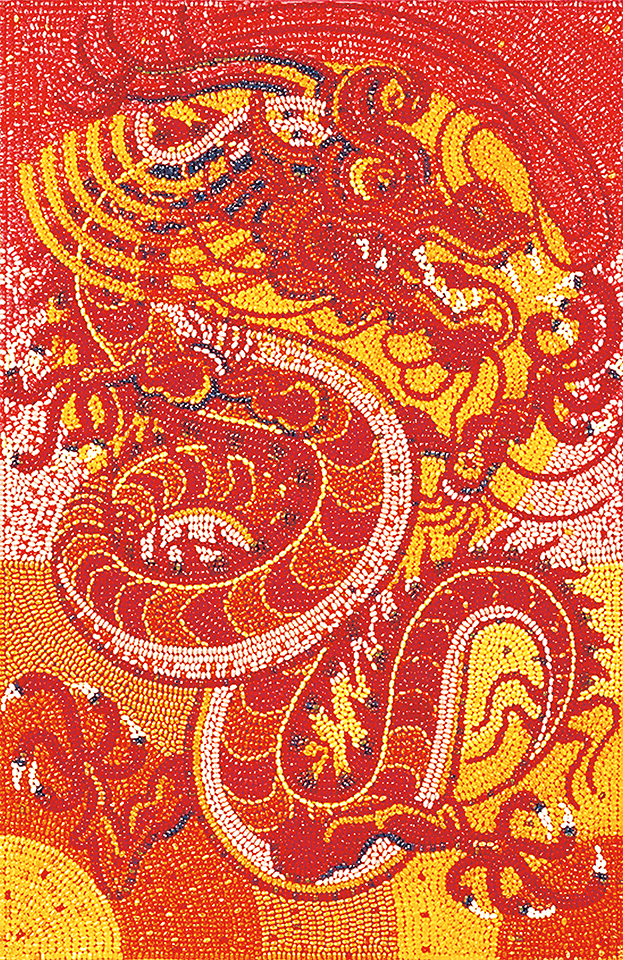
Lunar New Year Dragon
Made to celebrate the Lunar New Year, this portrait shows a dragon, the sign of good luck for the new year.
Lunar New Year Dragon
Artist: Peter Rocha
Dimensions: 6' x 4'
Main Palette
Red Apple
Very Cherry
Bubble Gum
Lemon
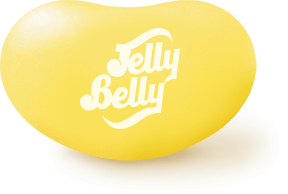 Crushed Pineapple
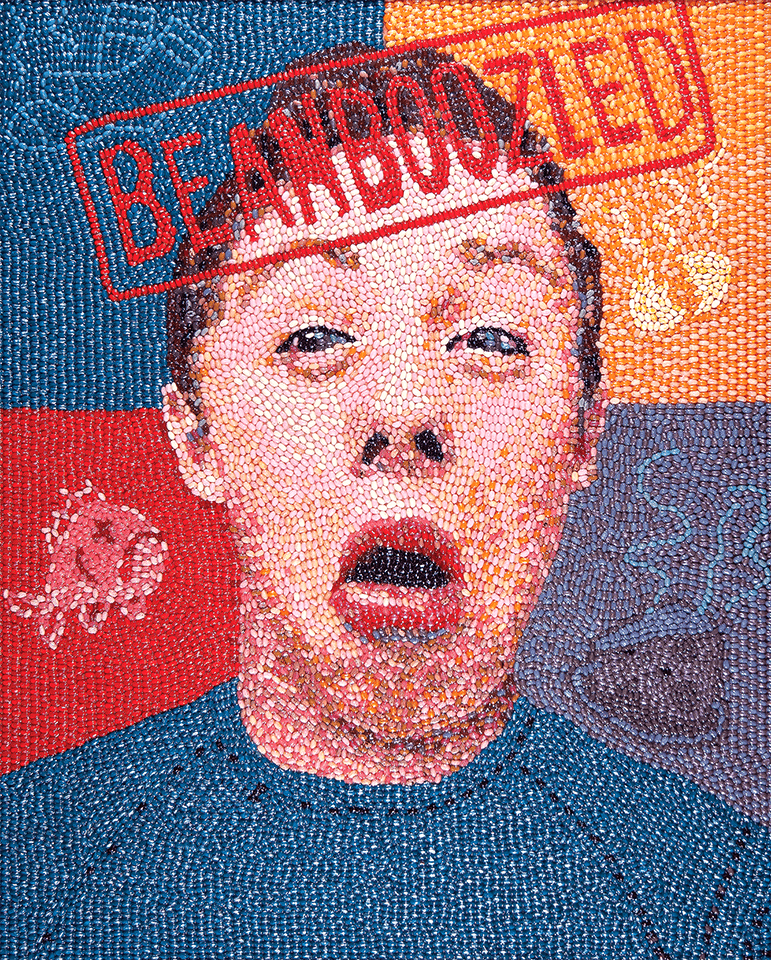
BeanBoozled
Consumers all over the world are having fun with BeanBoozled jelly beans, lookalike pairs of jelly beans that could be a delicious flavor or an intentionally gross one. Will it be Peach or Barf? Buttered Popcorn or Rotten Egg? Tutti-Fruitti or Stinky Socks? There’s only one way to find out!
BeanBoozled
Artist: Kristen Cumings
Dimensions: 4' x 5'
Main Palette
 Island Punch
 Jewel Orange
Blueberry
Bubble Gum
Very Cherry
Jewel Orange
Blueberry
Bubble Gum
Very Cherry
The
Jelly Belly Bean Art Gallery